
A 355
| Known as: | A 355; THT 989 |
|---|---|
| Cite this page as: | Gerd Carling; Adrian Musitz (translation). "A 355". In A Comprehensive Edition of Tocharian Manuscripts (CEToM). Created and maintained by Melanie Malzahn, Martin Braun, Hannes A. Fellner, and Bernhard Koller. https://cetom.univie.ac.at/?m-a355 (accessed 05 Jul. 2025). |
Edition | |
| Editor: | Gerd Carling; Adrian Musitz (translation) |
Provenience | |
| Main find spot: | Shorchuk |
| Specific find spot: | Stadthöhle |
| Expedition code: | T III Š 79.20 |
| Collection: | Berlin Turfan Collection |
Language and Script | |
| Language: | TA |
| Script: | late |
Text contents | |
| Title of the work: | Buddhastotra |
| Text genre: | Literary |
| Meter: | 43434 (4x); 5555 (1x), 444343 (1x), 55 (1x), 4443 (1x); 4343 (4x) |
Object | |
| Material: | ink on paper |
| Form: | Poṭhī |
| Number of lines: | 4 |
Images
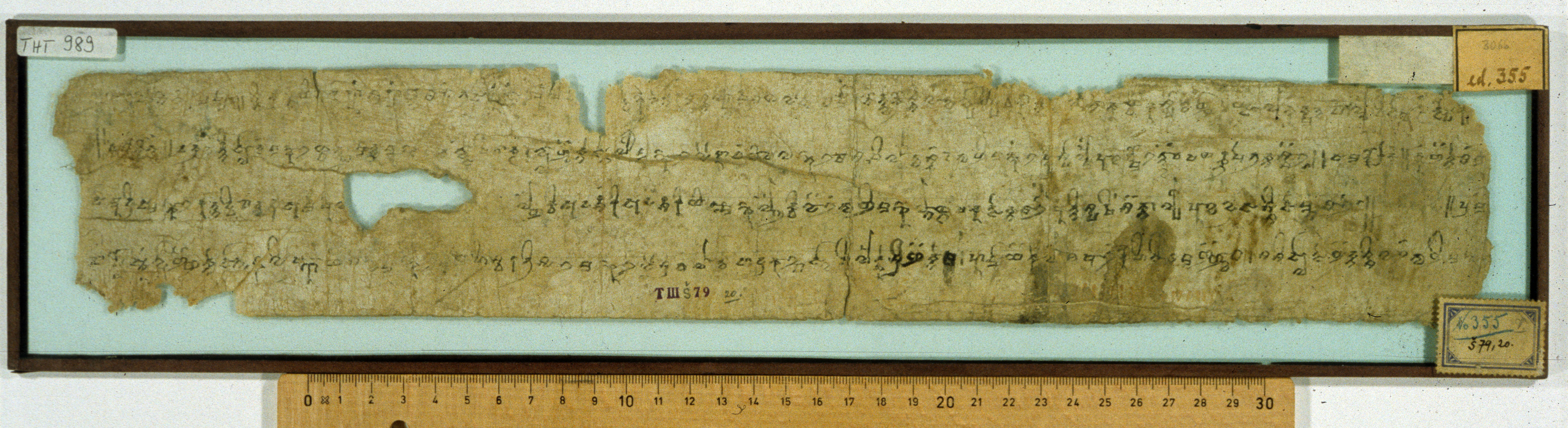

Images from idp.bl.uk by courtesy of the International Dunhuang Project, the Berlin-Brandenburgische Akademie der Wissenschaften, and the Staatsbibliothek zu Berlin – Orientabteilung.
Transliteration
| a1 | – [ṣi] – – ti n[aṃ] – m·· yā· ya śśi ka pśa ñi y[t]ā rymāṃ [tsa] ryāṃ [ā] sa ryāṃ tra sa – – – – – – – – ṅkā me – – śś· lyutā rm· ma¯ ¯s̝ w· – [p]a rmāṃ – t· rtw· kro śśi wa¯ ¯nt wyā bhyā e rkā t· – – tā ka¯ ¯s̝t ka ś[y]ā [ka] ññā – ysa lu ka km·¯ ¯nt pa lke [c]i swā raṃ tspo ky[o] /// |
|---|---|
| a2 | || vi [śi] ko naṃ || ca kkra va rtti slā¯ ¯nt ma ṅka¯ ¯l s̝pa tñ· mi ntu ma ṅka¯ ¯l n[äṃ] wsā ṣi [c]ā kra : wlā ññä kte st[a] lo ma ṅka¯ ¯l wai rā vaṃ – ¯ – o ṅka la¯ ¯m śa śi lā[¯] [¯ts] śkaṃ [:] tu ñi ma ṅka¯ ¯l pk[aṃ] śpā lmeṃ pu¯ ¯k cmo la ntw[ä]¯ ¯c ṣa s̝a rku me tra kna śśä¯ ¯l 1 || sa ma kko rre naṃ || tkaṃ ñä kte¯ ¯s ma – – – – – – – |
| a3 | sā mu dri sma ṅka¯ ¯l ra tna dvi pa [nt]· – su me rṣu l· (– – –) lñä kci su da rśaṃ ri su da rśa ri yi sma ṅka lñä kci wä¯ ¯l tu ñi ma ṅka lna¯ ¯s̝t ṣa ka tse k[n]a sa¯ ¯l pu tti śpa rṣiṃ śä ktā lyī pu¯ ¯k wra sa śśi se m[n]a sa¯ ¯l 1 || – – – – || pra m·ä – – – – – – – – |
| a4 | [¯m] [pl]o sk[eṃ] wlā ññä kte swā cra wi sṇu[¯] [¯yä] śa[¯] [¯ṅk] [ma] [ṅka¯] [¯l] – ma hi śva ra tri śu¯ ¯l ma ṅka¯ ¯l wai śra vaṃ lā¯ ¯nt bha dra ka¯ ¯lp swā ṣi le tke śri ñä kte¯ ¯s : hu mā¯ ¯yä kai lā¯ ¯k ṣu¯ ¯l ro hi ni¯ ¯s ma ññkä¯ ¯t : śa śi slā tse ñä kta śśi w[a]¯ ¯l tu ñi ma ṅka – – – – – – |
| b1 | || tsa [ppraṃ] || yma ssu ṣwra sa¯ ¯ñä pā sa ntra s[aṃ] va rṣi slyi mā kta ṅkā¯ ¯ñcä e ṅka lṣu rma¯ ¯s̝ : yma ssu ṣwra sa¯ ¯ñä mā pra ntra ā lu ṣñi wra¯ ¯m mā ko tne[¯] [¯cä] yo ñi prā kraṃ : ymā ssu ṣwra sa¯ ¯ñä ā lu śo¯ ¯l mā su mnā tra mā – nte¯ ¯ñc [s]i ms[aṃ] w[a] [r]ṣi : yma ssu ṣwra sa¯ ¯ñä – – – – – |
| b2 | [k]· [m]· [t]· – [r]s·¯ ¯ñc klyo mi nāṃ yt·¯ ¯r 1 | kā pñe ka – – – – ne yo || kā pñe ka naṃ || ynā nmu ne yo ṣī pwā tsaṃ ku sne ptā ñi kte peṃ wni¯ ¯s̝ : ne rvā ṣiṃ śä ktā lī sā tsra [ry]o¯ ¯s̝ – [nt]ā naṃ : tu ñi ṣña ṣṣe [t]a¯ ¯m ṣña ṣṣe ku ly[pa] [tra] [ku] [sne] |
| b3 | – – – śā pra kṣa ka ra mmā ga[¯] [¯t] s· nta¯ ¯k w[i] cma ntra ma ṇḍa¯ ¯l śāḫ ka pu rka¯ ¯t po tsāṃ krue ṣi ho || de wa seṃ ta pa¯ ¯kä e¯ ¯s̝ po sta kā spa ta¯ ¯lä yā msa su pu tti rśśa |
| b4 | pa rṣiṃ ā kā lo || |
Transcription
| a1 | – ṣi – – tinaṃ – m··yā·yaśśi kapśañi ytār ymāṃ tsäryāṃ āsäryāṃ trasa – – – – – – – – ṅkā me – – śś· lyutār m(e)maṣ w· – pärmāṃ – t· rtw·krośśi want wyābhyā erkāt· – – tākaṣt kaśyā käññā – ysalu kakm(u)nt pälke-ci swāräṃ tspokyo /// |
|---|---|
| a2 | ॥ viśikonaṃ ॥ |
| 1a | cakkravarttis ; lānt maṅkal ; ṣpät ñ(e)mintu ; maṅkal n-äṃ ; wsāṣi cākrä : |
|---|---|
| 1b | wlāññäktes ta;lo maṅkal ; wairāvaṃ – – 1σ ; oṅkaläm ; śaśi lāts śkaṃ : |
| 1c | tu ñi maṅkal ; pkaṃ śpālmeṃ ; puk cmoläntwäc ; ṣaṣärku ; metraknaśśäl 1 ॥ |
| * | samakkorrenaṃ ॥ |
|---|
| 1a | tkaṃ-ñäktes ma(ṅkal) ; – – – – – ; a3 sāmudris maṅkal ; ratnadvipänt· (:) |
|---|---|
| 1b | sumer-ṣul(is) ; (maṅka)l ñäkci ; sudarśaṃ ri ; sudarśa ; riyis maṅkal ; ñäkci wäl |
| 1c | tu ñi maṅkal naṣt ; ṣak atsek nasäl {:} |
| 1d | puttiśparṣiṃ ; śäktālyī ; puk wrasaśśi ; sem nasäl 1 ॥ |
| * | – – – – ॥ |
|---|
| 1a | pram (ñ)ä(ktes) (maṅkal) ; (maitträ) (ño)a4m ploskeṃ ; wlāññäktes wācrä ; wisṇuy śaṅk maṅkal (:) |
|---|---|
| 1b | mahiśvara ; triśul maṅkal ; waiśravaṃ lānt ; bhadrakalp ; {sw→ws}āṣi letke ; śri ñäktes : |
| 1c | humāy kailāk ṣul ; rohinis mañ ñkät : |
| 1d | śaśis lātse ; ñäktaśśi wal ; tu ñi maṅka(l) ; (pukaṃ) (śpālmeṃ) (1) b1 ॥ |
| * | tsappraṃ ॥ |
|---|
| 1a | ymassuṣ wrasañ ; pāsanträ ; saṃvarṣi slyi ; mā ktäṅkāñc ; eṅkäl ṣurmaṣ : |
|---|---|
| 1b | ymassuṣ wrasañ ; mā pranträ ; ālu ṣñi wram ; mā kotnec ; yoñi prākräṃ : |
| 1c | ymāssuṣ wrasañ ; ālu śol ; mā sumnāträ ; mā (mä)nteñc ; sim saṃwarṣi : |
| 1d | ymassuṣ wrasañ ; – – – ; – – b2 k· m· ; t· – 2σ rs·ñc 1σ ; klyomināṃ yt(ā)r 1 । |
| * | kāpñeka – – – – neyo ॥ kāpñe-kanaṃ ॥ |
|---|
| 1a | ynānmuneyo ; ṣīpwātsäṃ ; kus ne ptāñi;kte peṃ w{i}n{i→ā}ṣ : |
|---|---|
| 1b | nervā{ṃ}ṣi{nä}ṃ ; śäktāl{y}{ī→i} ; sā{tsräryo→säryurä}ṣ ; (sa)ntānaṃ : |
| 1c | tu ñi ṣñaṣṣe ; täm ṣñaṣṣe ; kulypaträ kus ne b3 – – |
| * | – śāp rakṣakaram māgat s(ā)ntak wic manträ maṇḍal śāḫkä purkät potsāṃ krue ṣiho ॥ dewaseṃ tapak eṣ postakā spatäl yāmsasu putti{rśśa→ś} |
|---|---|
| b4 | parṣiṃ ākālo ॥ |
Translation
| a1 | ... walking a road, a rough, dry ... beyond measure... carrying... you were... scornful... wind (?)... |
|---|---|
| a1+ | ... they see you, the one having come safely, with sweet taste. |
| a2 | In the Viśikoṃ-tune: The auspicious sign of the Cakravartin-king: The seven jewels. His auspicious sign is the golden wheel. The auspicious sign of Indra: The vajra, the elephant wairāvaṃ(cit)(=Airāvata), and queen Śacī. You are my auspicious sign, best among all, having surpassed all births with Maitreya (?). |
| a2+ | The auspicious sign of the earth: ... The auspicious sign of the Ocean: the jewel-islands. The auspicious sign of mount Sumeru: the divine city Sudarśana. The auspicious sign of the city Sudarśana: the divine king. |
| a3 | You are certainly to be my auspicious sign. The seed of Buddhahood is to be the refuge of all beings. |
| a3+ | The auspicious sign of Brahman: The name "friendship" (maitträ), meditation. Of Indra: The vajra. Of Viṣṇu: The conch shell. The auspicious sign of Vaiśravaṇa: The king-trident. Of Śrī: The present age, the golden vine. Of Umā: Mount Kailāśa. Of Rohiṇī: The moon. Of queen Śacī: The king of the gods. |
| a4+ | You are my auspicious sign, best among all. |
| b1 | In the Tsappra-tune: Conscious beings keep the rules of self-discipline and do not transgress them because of passion. Conscious beings do not take the own property of others. They do not break the firm path. Conscious beings do not take another's life. They do not offend (= transgress) the limit of restraint. |
| b1+ | Conscious beings... the noble path... |
| b2 | In the Kāpñekaṃ-tune: Who worships the feet of the Buddha with unguent-like reverence, having sown the seed of Nirvāṇa in the succession (of births), you are my relative, who desires a relative... |
| b3+ | Devasena gives penalty, putting trust in (this) Puṣtaka, with the wish for Buddhahood. |
Other
| b1 | Verständige Menschen bewahren die Regel der Selbstzucht. (Schmidt 1974: 84) |
|---|---|
| b1 | Die verständigen Wesen nehmen anderen nicht [ihr] Eigentum [fort]. (Schmidt 1974: 406) |
| b1 | Die verständigen Wesen nehmen anderen nicht das Leben [und] verletzen nicht die Grenze des Samvara. (Schmidt 1974: 408) |
| b1 | Verständige Wesen wahren die Regel des Saṃvara [und] überschreiten [sie] nicht aus Leidenschaft. (Schmidt 1974: 405) |
| b1 | Die bedachtsamen Wesen nehmen anderen nicht das Leben [und] verletzen nicht die Grenze des Saṃvara. (Schmidt 1974: 164) |
| b2 | Wer mit ... Ehrerbietung die Füße des Buddha verehrt, den Samen des Nirvāṇas in [seine] Geburtenfolge gesät habend, der wird(?) [in dem Gedanken]: "Du bist mein Verwandter" [als] Verwandter begehrt. Wer... (Schmidt 1974: 244) |
Commentary
Remarks
| Transcription and translation are based on Carling et al. 2009. | |
| Transcription and references have been transferred from the "Text and Reference Database of the Tocharian A Language" (Gerd Carling Lund University) (funded by the Bank of Sweden Tercentenary Foundation and SCAS). |
References
Online access
Edition
Sieg and Siegling 1921: 196-197; Sieg and Siegling 1921 p. 196, p. 197
Translations
Carling 2000: a1 (92); Couvreur 1959: a1 (252), a2 (252), a3 (252), b1 (252), b2 (252); Hackstein 1995: b1 (175); Knoll 1996: a1 (121), a2 (89), a6 (102), b1 (91, 99, 102); Kölver 1965: a2 (118); Schmidt 1974: b1 (84, 164, 405, 406, 408), b1 (84), b1 (406), b1 (408), b1 (405), b1 (164), b2 (244); Thomas 1952: a3 (32); Thomas 1958a: a2 (152); Thomas 1967a: a2 (67); Thomas 1967c: a2 (177); Thomas 1969: a2 (261), a4 (242); Thomas 1970: a4 (275)
Bibliography
Carling, Gerd. 2000. Die Funktion der lokalen Kasus im Tocharischen. Berlin/New York: de Gruyter.
Carling, Gerd, Georges-Jean Pinault, and Werner Winter. 2009. A dictionary and thesaurus of Tocharian A. Volume 1: Letters a-j. Wiesbaden: Harrassowitz.
Couvreur, Walter. 1959. “Review of: Thesaurus Linguae Tocharicae Dialecti A.” Bibliotheca Orientalis 16 (5-6): 251–53.
Hackstein, Olav. 1995. Untersuchungen zu den sigmatischen Präsensstammbildungen des Tocharischen. HS Erg.-Heft 38. Göttingen: Vandenhoeck & Ruprecht.
“The International Dunhuang Project: The Silk Road Online.” n.d. http://idp.bl.uk.
Knoll, Gabriele. 1996. “Die Verwendungsweisen der Adjektive im Tocharischen.” PhD, Universität Frankfurt am Main.
Kölver, Bernhard. 1965. “Der Gebrauch der sekundären Kasus im Tocharischen.” PhD, Universität Frankfurt am Main.
Schmidt, Klaus T. 1974. “Die Gebrauchsweisen des Mediums im Tocharischen.” PhD, Universität Göttingen.
Sieg, Emil, and Wilhelm Siegling. 1921. Tocharische Sprachreste, I. Band. Die Texte. A. Transcription. Berlin/Leipzig: de Gruyter.
Sieg, Emil, and Wilhelm Siegling. 1921. Tocharische Sprachreste, I. Band. Die Texte. A. Transcription. Personal annotated copy of Wilhelm Siegling. Scanned by Douglas Q. Adams with the technical assistance of Michael Tarabulski and Kevin Dobbins. Berlin/Leipzig: de Gruyter.
Thomas, Werner. 1952. Die tocharischen Verbaladjektive auf -l. Deutsche Akad. der Wissenschaften zu Berlin, Institut für Orientforschung 9. Berlin: Akademie-Verlag.
Thomas, Werner. 1958a. “Zum Ausdruck der Komparation beim tocharischen Adjektiv.” Zeitschrift für Vergleichende Sprachforschung 75: 129–69.
Thomas, Werner. 1967a. “Zu den Ausdrücken mit A ñom, B ñem im Tocharischen.” Indogermanische Forschungen 72: 58–78.
Thomas, Werner. 1967c. “Zu wortverbindendem toch. A śkaṃ/ B ṣpä.” Zeitschrift für Vergleichende Sprachforschung 81: 161–80.
Thomas, Werner. 1969. “Bemerkungen zum Gebrauch von toch. A ptāñkät [B pañäkte, pudñäkte], A koṃ [B kauṃ]: A koṃñkät [B kauṃñäkte] usw.” Orbis 18: 235–68.
Thomas, Werner. 1970. “Zu einer stilistischen Besonderheit im Tocharischen.” Zeitschrift für Vergleichende Sprachforschung 84: 254–80.
Gippert, Jost, Katharina Kupfer, Christiane Schaefer, and Tatsushi Tamai. n.d. “Thesaurus Indogermanischer Text- und Sprachmaterialien (TITUS): Tocharian Manuscripts from the Berlin Turfan Collection.” http://titus.fkidg1.uni-frankfurt.de/texte/tocharic/thtframe.htm.



