Work in progress
YQ III.12
| Known as: | YQ III.12; YQ 1.27 |
|---|
| Cite this page as: | "YQ III.12". In A Comprehensive Edition of Tocharian Manuscripts (CEToM). Created and maintained by Melanie Malzahn, Martin Braun, Hannes A. Fellner, and Bernhard Koller. https://cetom.univie.ac.at/?m-yqiii12 (accessed 05 Jul. 2025). |
|---|
Provenience |
| Main find spot: | Qigexing |
|---|
| Collection: | Xinjiang Museum (Ürümchi) |
|---|
Language and Script |
| Language: | TA |
|---|
| Script: | classical |
|---|
Text contents |
| Title of the work: | Maitreyasamiti-Nāṭaka |
|---|
| Passage: | Act 3.12 |
|---|
| Text genre: | Literary |
|---|
| Text subgenre: | Drama |
|---|
| Verse/Prose: | prose; verse |
|---|
| Meter: | 43434 (4x) |
|---|
Object |
| Manuscript: | Yanqi |
|---|
| Material: |
ink
on paper |
|---|
| Form: | Poṭhī |
|---|
| Number of lines: | 8 |
|---|
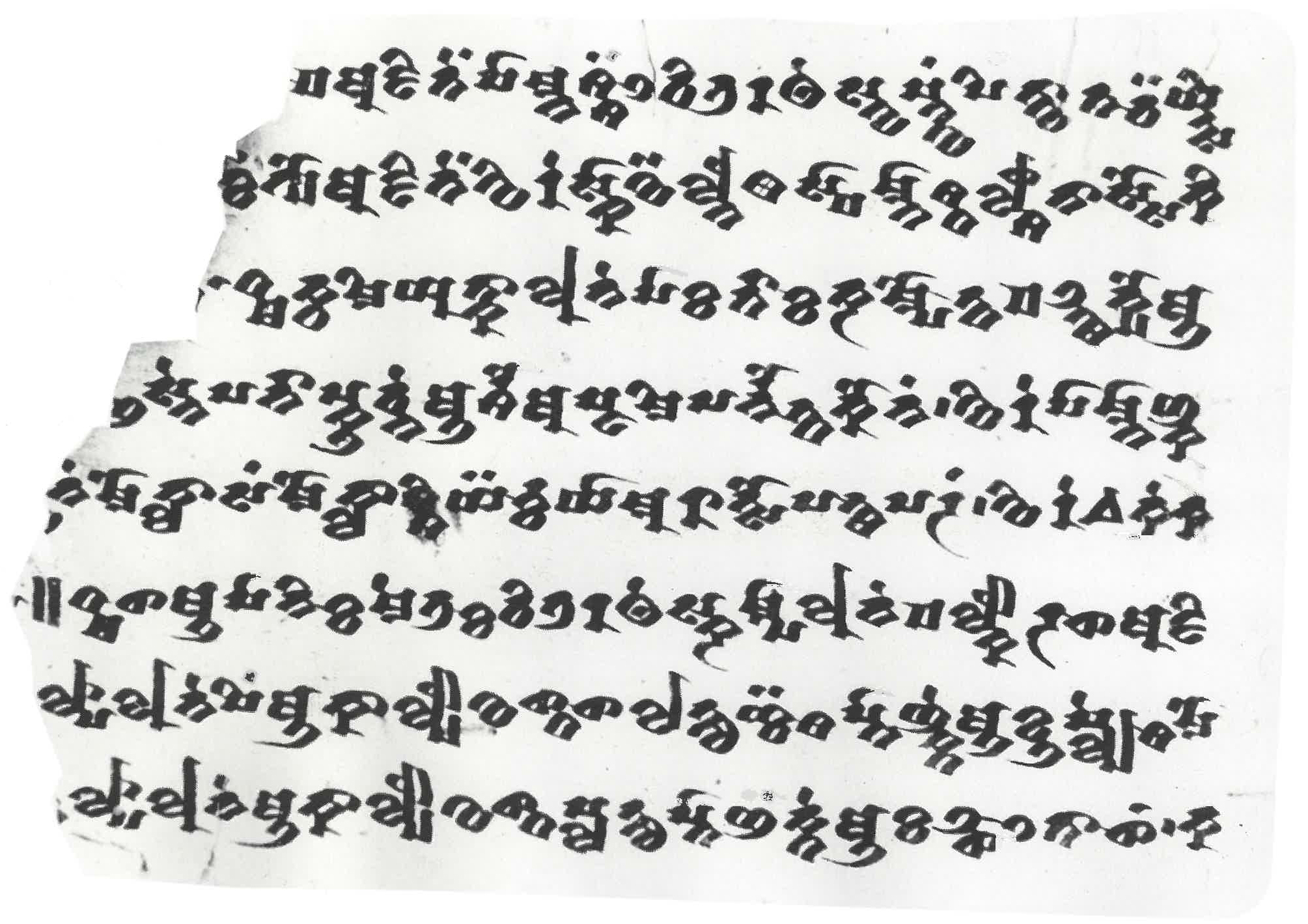
Images
Transliteration
| a1 | /// ¯p a ji teṃ ṣā mna śśä¯ ¯l ci tra ra the swa ṣtwaṃ piṃ twā ta¯ ¯cä ytsi |
|---|
| a2 | /// ka[ṃ] nyo a ji teṃ wi re skā wä lte na sṣā mnā sta lśi nā sso ki |
|---|
| a3 | /// – • tma kca mi yu tkā lu ne pā ka rtā¯ ¯k kra mpo¯ ¯nt pa ltsa kyo ā |
|---|
| a4 | /// ·ñ· sne pa rnā pku cne ā rśo a ṣṭa mi pa rno¯ ¯nt ko naṃ : wi re ṣā mnā ñka |
|---|
| a5 | /// – ne mo klā saṃ mo klā śśi yä¯ ¯rk yā mu rā tso pa¯ ¯ts pa raṃ : wi re e kre kā |
|---|
| a6 | /// 1 || tma¯ ¯s̝ ā ṣā ni¯ ¯k me tra¯ ¯k ci tra ra the skra mpā lu ne pa lko ra¯ ¯s̝ a ji |
|---|
| a7 | /// lpā lu ne ṣiṃ ā kā lyo wa s̝ta¯ ¯s̝ la ntu ñcä¯ ¯s ptā ñkte ā kla ṣlye¯ ¯s mo |
|---|
| a8 | /// [t](·)· lpā lu ne ā kā lyo wa s̝ta ṣla ntu ptā ñä kte ā ka ls̝a¯ ¯l tā¯ ¯s̝ : kā |
|---|
| b1 | /// [ma] ska ta rko naṃ śtwa rā¯ ¯k tmā ni spa¯ ¯t yä¯ ¯rk wä rpnā tsi : ku cpra ks̝a¯ ¯l wi¯ ¯r |
|---|
| b2 | /// ṅka s̝ta mne tu tā pa¯ ¯rk ca ṣi ma rka mpa lpā kṣi ñmaṃ tne sa¯ ¯s pkaṃ ṣi ya |
|---|
| b3 | /// ¯s̝ ptā ñka tka ṣyā¯ ¯p yā tña lsa¯ ¯s mā wa saṃ || tma¯ ¯s̝ ci tra ra the kā tse ka kmu |
|---|
| b4 | /// ¯nt pa ltsa kyo tsru caṃ wi nā ssi le¯ ¯k yā mu ra¯ ¯s̝ tra ṅka¯ ¯s̝ pi¯ ¯cä a ne |
|---|
| b5 | /// prā ryo s̝a rpa smāṃ tra ṅka¯ ¯s̝ pla ma¯ ¯s • tma ṣwä rce spa ktā ni kāṃ a¯ ¯ts |
|---|
| b6 | /// śśä¯ ¯l ra ri twu¯ ¯nt sne ynā ñmu ne yo su ko ra ṣṣo ma ka lyme s̝ma |
|---|
| b7 | /// rp[o] ra¯ ¯s̝ wa ltsu rā tsru caṃ ci tra ra the sma rka mpa¯ ¯l ā kṣi ññu ra |
|---|
| b8 | /// [¯]s̝ ā rśo pa rno¯ ¯nt a ṣṭa mi ko naṃ sne pa raṃ ma ska mā¯ ¯r kuya |
|---|
Transcription
Translation
| a1+ | ... together with the monk Ajita, to beg for alms in the house of Citraratha ... |
|---|
| a2+ | (Metr)ak and Ajita, young and attractive monks like ... |
|---|
| a3 | Thereupon his sorrow came to the fore, and with a worried mind (to the venerable) ... |
|---|
| a4 | ... of me, a person without status, when today on the glorious eighth day, young monks ... |
|---|
| a5 | ... among the old ones homage to the old means great glory; |
|---|
| a5+ | young, empty, (attractive) ... |
|---|
| a6+ | Then the venerable Metrak having noted Citraratha's sorrow, to Ajita ... |
|---|
| a7+ | ... those having left the house, wanting salvation, the (old ones) ..., the disciples of the Buddha ... |
|---|
| a8+ | having left the house, wanting salvation, he will be a disciple of the Buddha... |
|---|
| b1 | is (in a position) to receive every day the homage to the Stūpa consisting of 400,000 [coins]. What is the problem? |
|---|
| b1+ | Young ... |
|---|
| b2 | ... says: |
|---|
| b2+ | This being the case, you pronounce now for him the Law, so that he is in everything together ... |
|---|
| b3 | Then he is to be controlled by Buddha-god the teacher, not by us. |
|---|
| b3+ | || Then Citraratha, having come close, ... with a (worried) mind having made only some weak gesture of veneration, says: |
|---|
| b4+ | Go inside ... |
|---|
| b5 | ... pointing with his finger, says: Sit down! |
|---|
| b5+ | Thereupon, an inferior servant indeed ... |
|---|
| b6+ | having brought (?) without the due respect combined with ..., he sits down by himself ... |
|---|
| b7+ | having received ..., and having briefly proclaimed some basic teaching of the Law to Citraratha, ... |
|---|
| b8 | I am today on the glorious eighth day without status. Why? |
|---|
Other
| a8 | Having left the house in the wish for salvation, he will be a disciple of the Buddha. (cf 197) (Peyrot 2013b: 629) |
|---|
Commentary
Parallel texts
| * | MaitrHami 3, 11-12?; MaitrSiŋgim |
|---|
Remarks
| * | This fragment contains part of the third act of the Maitreyasamitināṭaka; Uy. parallels are MaitrHami 3, 11b(?)-12b(?) and MaitrSiŋgim, Taf. 25+49 (Tekin 1980: 222). See also Pinault 1999: 196-7. |
|---|
| * | The translation and the following commentary are adapted from Ji et al. 1998: 198. |
|---|
Philological commentary
| n1 | Cf. Uyghur text, Turfan version, Taf. 99, "Rückseite" (but to be turned over) = recto, lines 4-5 (Tekin 1980: 225). For this leaf, there is no matching text in the Hami version of Maitrisimit. |
|---|
| n2 | Cf. Tekin 1980: 225, Taf. 99, recto, lines 7-9. |
|---|
| n3 | Cf. Tekin 1980: 221, Taf. 92, verso, lines 4-7. |
|---|
| n4 | Cf. Taf. 99, "Vorderseite" (but to be turned over) = verso, lines 3-7 (Tekin 1980: 224). |
|---|
References
Edition
Ji et al. 1998
Translations
Peyrot 2013b: a8 (629)
Bibliography
Ji et al. 1998
Ji, Xianlin, Werner Winter, and Georges-Jean Pinault. 1998. Fragments of the Tocharian A Maitreyasamiti-Nāṭaka of the Xinjiang Museum, China. Transliterated, translated and annotated by Ji Xianlin in collaboration with Werner Winter, Georges-Jean Pinault. TLSM 113. Berlin/New York: de Gruyter.
Peyrot 2013b
Peyrot, Michaël. 2013b. The Tocharian subjunctive. A study in syntax and verbal stem formation. Vol. 8. Brill’s Studies in Indo-European Languages & Linguistics. Leiden/Boston: Brill.
Pinault 1999
Pinault, Georges-Jean. 1999. “Restitution du Maitreyasamiti-Nāṭaka en tokharien A: Bilan provisoire et recherches complémentaires sur l’acte XXVI.” Tocharian and Indo-European Studies 8: 189–240.
Tekin 1980
Tekin, Şinasi. 1980. Maitrisimit nom bitig. Die uigurische Übersetzung eines Werkes der buddhistischen Vaibhāṣika-Schule. 1. Teil: Transliteration, Übersetzung, Anmerkungen. 2. Teil: Analytischer und rückläufiger Index. Schriften zur Geschichte und Kultur des Alten Orients, Berliner Turfantexte, IX. Berlin: Akademie-Verlag.