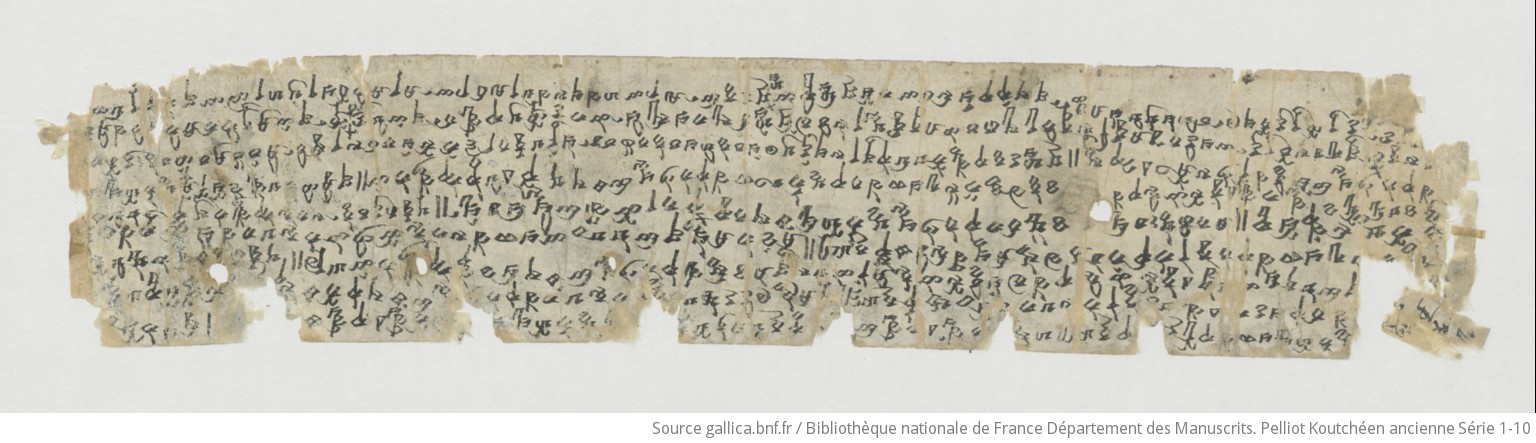

Images from gallica.bnf.fr by courtesy of the Bibliothèque nationale de France, Département des Manuscrits, Pelliot koutchéen.
CEToM | PK AS 8B
| Known as: | PK AS 8B; Pelliot Koutchéen Ancienne Série 8B; M 2 |
|---|---|
| Cite this page as: | Georges-Jean Pinault; Melanie Malzahn (collaborator). "PK AS 8B". In A Comprehensive Edition of Tocharian Manuscripts (CEToM). Created and maintained by Melanie Malzahn, Martin Braun, Hannes A. Fellner, and Bernhard Koller. https://cetom.univie.ac.at/?m-pkas8b&outputformat=print (accessed 09 Jul. 2025). |
Edition | |
| Editor: | Georges-Jean Pinault; Melanie Malzahn (collaborator) |
| Date of online publication: | 2014-02 |
Provenience | |
| Main find spot: | Subashi |
| Specific find spot: | Ouest, grande enceinte |
| Expedition code: | M 777.2 |
| Collection: | Bibliothèque nationale de France, fonds Pelliot Koutchéen (Paris) |
Language and Script | |
| Language: | Skt.; TB |
| Linguistic stage: | classical |
| Add. linguistic characteristics: | late |
| Script: | classical |
Text contents | |
| Text genre: | Literary |
| Text subgenre: | Medicine/Magic |
| Verse/Prose: | prose |
Object | |
| Manuscript: | PK AS 8 |
| Material: | ink on paper |
| Form: | Poṭhī |
| Size (h × w): | 7.4 × 36.2 cm |
| Number of lines: | 9 [recto], 6 [recto] |
| Interline spacing: | varies between 1 and 0.5 [recto]. 1 and 0.9 [verso] cm |
Images from gallica.bnf.fr by courtesy of the Bibliothèque nationale de France, Département des Manuscrits, Pelliot koutchéen.
| a1 | (– –) py(·) (–) [p]wa rne ho mya ma s̝a le ka ryo r (–) [ṅ]k(·) tra 10-1 || ha ste (– –) no lmeṃ e ka lmī yā (– –) knā tra po śa tre po [tk](·) (– –) – [pyo] pwa rne ho mya m·· – [o] no lmī e ka lmī ma (– – – –) || svā ti ne mo¯ ¯t |
|---|---|
| a2 | (– –) ku (–) le tā kaṃ ma da na pha lṣe ṣa¯ ¯t twe re ne ·sa pa na l[e] mo¯ ¯t spa rke tra 10 3 || su śā khne kha di ra ṣṣe ṣa[¯] [¯t] tw[e] r(·) ne tsa pa na le ke te ñ(·) [m]tsa yā maṃ su ke to ma ske(·) ra (–) sā lkaṃ mo kṣa 10 4 – |
| a3 | (– – –) tn[e] śā mñe a yā ṣe cu¯ ¯rm ya ma ṣle e tve so ye tsi ka le tu meṃ cwi so ye tse śi reṃ ye pe sa ā śe ka rstā lya ke te ñe mtsa yā maṃ su mā wa lke nke lyñe ne yaṃ 10 5 || pu rvva [s̝ā] [t]n(·) pa l[ly]ī ye ṣṣe pi tsau – |
| a4 | [ṣ]u¯ ¯kt nä sai tya ma s̝a le ke te tve re ne kā taṃ ce¯ ¯u o sne śā mna li tsā vi ma ske tra 10 7 || śā waṃ ne śā mñe a yā ṣe ṣa¯ ¯t ya ma s̝a le sa na tse yo ñi ye ne tsa pa na le mai yo ku le ta rne |
| a5 | kwrī no ṣa¯ ¯t sā lkaṃ mo kṣa || śa ta bhi ṣne : ca mpā ○ ka ṣṣai tā na ke te ñe mtsa pwa rne ho myā maṃ su ta kca ke ta ra yo lo yā mtsi mā ca mpaṃ • || pu rvva bha dra va tne • sa na tse nke lyñe ne sru ko ṣe pi [pa] – |
| a6 | ka ṣa pyā pyo wa ltsa na lya e tve so ye tsi ka le ○ ka nte o¯ ¯kt nä sai tya ma s̝a le ta ka pwa rne ṣa la s̝a le ke te ñe mtsa yā ma su ṣu kau e pi kte nke lñe ne yaṃ || a śvi ṇi ne ṣa lype wai mo ro śkaṃ pwa rne ho mya ma – |
| a7 | le ke te ñe mtsa yā maṃ cwi la rau ñe sa śau¯ ¯l e ṅka stra || bra hma da tta ka lpne nau¯ ¯ṣ pā ke ā ra sa mu draṃ pra tha maṃ va nte hi ma va nte ta thai vā ca • me rūṃ pa rvva ta rā jā nāṃ so maṃ ta thā sa ra svā ti • śi vaṃ vai śra va ṇaṃ va nte : u bhau na ra |
| a8 | ta sa tva tau • ā tyā va sa vo ru dra • ya ma di na • ca śa rvva rī si ndhu ti rya sya bha va ṇe ga ndha rvvā ptsa ra se vi tuṃ brā hmi cā sya na ma syā mi • ye na da ṇḍo pra ka lpi tā • a yaṃ hi dā «ru» «ṇo» ṇḍo • a yaṃ śra trū ni nā śa ti (–) ni la śri – |
| a9 | (–) va ra dā • da ru ṇo ru dra to mu kha • vā hi me pre ṣi me ga ccha • a su kaṃ ka rma sā dhā ya na mo bra hmā kṣi ya bra «hma» da tta yā śu rā ya ha la mu sa la pa ra śu dhā rā ya • śa ra śa [k](·)i dho ma ra pra ha ra ṇā ya a ne [k](·) ru pā ya |
| b1 | (– –) [m]ā da ṅgā nāṃ na mo mā da ṅgi nu nāṃ • na mo mā da ṅga dā ra kā nāṃ na mo mā da ṅga dā ri kā nāṃ na mo mā da ṅga cā ryā ṇāṃ • na mo mā ṇga si ddhā nāṃ • na mo mā da «ṅga» rṣī ṇāṃ • na mo mā «da» ṅga śu klā nāṃ • na mo mā da ṅga kṛ ṣṇā nāṃ • [na] [m](·) [mā] [da] [ṅ]ga p(·) |
| b2 | [r](·) (–) rā yāṃ • na mo mā da ṅga ku la vaṃ śa sya • na mo mā da ṅga vṛ ddha nāṃ • ye ke ci dvi dyā dha rā • na mo vi śma mi tra sya mā da ṅga rā ja sya • na mo mā da ṅga de vā nāṃ • na ma skṛ śa ṅku sya mā da ṅga rā ja sya • na ma ḥ pra si ddha sya • na mo rū rū sya (–) mo u ṣṭra sya |
| b3 | mā da ṅga rā ja sya • hi li e hi • e hi • mā la da ṇḍi ke • mā da ṅgā nu jñā ti ke • mā hu ri ke • sa rva ka rmā ṇi kā ri ke • i daṃ ka rma ka ro hi me • mā me vi ghnaṃ ka ri ṣya si • du mpe • du ḍu du mpe • ka la śo da ri • kā ḍi • kā ḍi mā hā kā ḍi • kā la pi(·) ga li • ka ḍa |
| b4 | (– –) • ccha ndi ma hā gho ri • pā tra ka pā la dhā ri ṇi ○ śma śā na vā si nī • ru dhi raṃ ma ṅsa bha kṣī ṇī • vā yu ja pe • sa mu dra a ti kra ma no dhi ke • vi ki • vi mi • e ka ru ṣe • kā ḍa me ghe • hā hā hi hi re • hu hū re svā ha || se mā la da |
| b5 | (–) tse ā (–) haṃ ṣu¯ ¯kt we ṣle pa rwe ṣṣe meṃ || na mo mā da ṅgā nāṃ • na mo mā da ṅgi kā nāṃ • na mo mā da ṅga dā ra kā nāṃ • na mo mā da ṅga dā ri kā nāṃ • na mo mā da ṅga ā cā rya ṇāṃ • na mo mā da ṅga si ddhā nāṃ • na mo mā da ṅga rṣī ṇāṃ • na mo mā da ṅga śu klā n·ṃ – |
| b6 | (– –) mā da – – ṣṇā ṇāṃ • na mo mā da ṅga pa ra mbha rā yāṃ na mo mā da ṅga ku la vaṃ śa sya • na mo mā da ṅga vṛ ddhā nāṃ • ye ke ci dva dha rā • na mo vi· [v]· mi tra mā da ṅga rā ja sya • na mo mā da ṅga de vā nāṃ • na ma stṛ śaṃ ku la sya • [m]ā – ṅga r(·) (–) sya • na ma • pra si ddha sya |
| a1 | n1 – – py(āpyo) pwarne hom yamaṣäle karyor (plä)ṅk(e)trä 10{†-1} ॥ haste(ne) (o)nolmeṃ ekalmī yā(mtsi) (pä)knāträ po śatre po tk· – (po) (pyā)pyo pwarne hom yam(aṣäle) onolmī ekalmī mä(skenträ) (10-1) ॥ svātine mot |
|---|---|
| a2 | n2 (kete) ku(rpe)le tākaṃ madanaphalṣe ṣat twerene (t)sapanale mot spärketrä 10-3 ॥ suśākhne khadiräṣṣe ṣat twer(e)ne tsapanale kete ñ(e)mtsa yāmäṃ su keto mäske(t)rä (kwri) sālkaṃ mokṣa 10-4 (॥) |
| a3 | n3 (anura)tne śāmñe ayāṣe curm yamaṣle etve soye tsikale tumeṃ cwi soyetse śireṃ yepesa āśe kärs{t→n}ālya kete ñemtsa yāmäṃ su mā walke nkelyñene yaṃ 10-5 ॥ purvvaṣātn(e) pällyīyeṣṣe pit sau(käṃ) |
| a4 | n4n5 ṣukt näsait yamaṣäle kete tverene kātaṃ ceu osne śāmna litsāvi mäsketrä 10-7 ॥ ś{r}āwaṃne śāmñe ayāṣe ṣat yamaṣäle sanatse yoñiyene tsapanale maiyo kuletär-ne |
| a5 | kwrī no ṣat sālkaṃ mokṣa {21} ॥ śatabhiṣne : campākäṣṣai tāna kete ñemtsa pwarne hom yāmäṃ su {n}ta kca ketara yolo yāmtsi mā camp{a→ä}ṃ • {23} ॥ purvvabhadravatne • sanatse nkelyñene srukoṣepi pä(sa)¬ |
| a6 | käṣan6 pyāpyo waltsanalya etve soye tsikale känte okt näsait yamaṣäle taka pwarne ṣaläṣäle kete ñemtsa yāmä{ṃ} su ṣu= kau{ṃ} epikte nkelñene yaṃ {24} ॥ aśviṇine ṣalype wai morośkaṃ pwarne hom yama(ṣä)¬ |
| a7 | le kete ñemtsa yāmäṃ cwi larauñesa śaul eṅkasträ {27} ॥ brähmadattakalpne nauṣ pāke āra samudraṃ prathamaṃ vante himavante tathaivāca • merūṃ parvvatarājānāṃ somaṃ tathā sarasvāti • śivaṃ vaiśravaṇaṃ vante : ubhau nara¬ |
| a8 | tasatvatau • ātyā vasavo rudra • yamadina • ca śarvvarī sindhutiryasya bhavaṇe gandharvvāptsarasevituṃ brāhmicāsya namasyāmi • yena daṇḍo prakalpitā • ayaṃ hi dāruṇo {da}ṇḍo • ayaṃ śratrūni nāśati – nila śri – |
| a9 | – varadā • daruṇo rudrato mukha • vāhi me preṣi me gaccha • asukaṃ karmasādhāya namo brähmākṣiya brähmadattayā śurāya halamusalaparaśudhārāya • śaraśak(t)idhomarapraharaṇāya anek(a)rupāya |
| b1 | (namo) mādaṅgānāṃ namo mādaṅginunāṃ • namo mādaṅgadārakānāṃ namo mādaṅgadārikānāṃ namo mādaṅgacāryāṇāṃ • namo mā{da}ṇgasiddhānāṃ • namo mādaṅgarṣīṇāṃ • namo mādaṅgaśuklānāṃ • namo mādaṅgakṛṣṇānāṃ • nam(o) mādaṅgap(a)¬ |
| b2 | r(ambha) rāyāṃ • namo mādaṅgakulavaṃśasya • namo mādaṅgavṛddhanāṃ • ye ke cid vidyādharā • namo viśmamitrasya mādaṅgarājasya • namo mādaṅgadevānāṃ • namas kṛśaṅkusya mādaṅgarājasya • namaḥ prasiddhasya • namo rūrūsya (na)mo uṣṭrasya |
| b3 | mādaṅgarājasya • hili ehi • ehi • māladaṇḍike • mādaṅgānujñātike • māhurike • sarvakarmāṇi kārike • idaṃ karma karohi me • mā me vighnaṃ kariṣyasi • dumpe • duḍudumpe • kalaśodari • kāḍi • kāḍi māhākāḍi • kālapi(ṅ)gali • kaḍa¬ |
| b4 | (raudrī) • cchandi mahāghori • pātrakapāladhāriṇi śmaśānavāsinī • rudhiraṃ maṅsabhakṣīṇī • vāyujape • samudra atikramanodhike • viki • vimi • ekaruṣe • kāḍameghe • hā hā hi hi re • hu hū re svāha ॥ se mālada¬ |
| b5 | (ṇḍi)tse ā(va)haṃ ṣukt weṣle pärweṣṣemeṃ ॥ namo mādaṅgānāṃ • namo mādaṅgikānāṃ • namo mādaṅgadārakānāṃ • namo mādaṅgadārikānāṃ • namo mādaṅga ācāryaṇāṃ • namo mādaṅgasiddhānāṃ • namo mādaṅgarṣīṇāṃ • namo mādaṅgaśuklān(ā)ṃ (•) |
| b6 | (namo) māda(ṅgakṛ)ṣṇāṇāṃ • namo mādaṅgaparambharāyāṃ namo mādaṅgakulavaṃśasya • namo mādaṅgavṛddhānāṃ • ye ke cid vadharā • namo vi(ś)v(a)mitramādaṅgarājasya • namo mādaṅgadevānāṃ • namas tṛśaṃkulasya • mā(ta)ṅgar(āja)sya • nama • prasiddhasya |
| a1 | A ... flower [is] to be put [lit. made] into the fire as an oblation, [and] the bought [goods] are (so)ld. 10. In [the lunar mansion] Hastā [if] one intends to make subject living beings, any kind of cereal, any kind of ..., (any kind of flo)wer [is] to be put [lit. made] into the fire as an oblation, [and] the living beings be(come) subject. (11). |
|---|---|
| a1+ | In [the lunar mansion] Svāti (who) should be careful with wine, a piece of the madana fruit [= Randia dumetorum] [is] to be mashed in the door, |
| a2 | [and] the wine will disappear. 13. In [the lunar mansion] Suśākhā a piece [thorn?] of khadira [wood] [= Acacia catechu] [is] to be crushed in the door, in whose name one does [that], this one will be destroyed. [If] one pulls [it] out, [it means] release [= Skt. mokṣaḥ]. 14. |
| a3 | In [the lunar mansion] Anurādhā powder of human bones [is] to be made and then a puppet [is] to be fashioned. Thereupon the head of this puppet should be cut off with a sharp knife. In whose name one does [it], this one before long will [lit. goes to] perish. 15. |
| a3+ | In [the lunar mansion] Pūrvāṣādhā [if] one dis(plays?) gall from the ..., one has to cast [lit. make] a spell seven times. |
| a4 | In whose names one strews [= the gall] in the door, in this house the people become [like] the Licchavi [people]. 17. In [the lunar mansion] Śrāvana a splitter of human bones [is] to be made; it has to be crushed on the passage of the enemy, [and] his strength will recede. |
| a5 | But if one pulls [it] out, [it means] release [= Skt. mokṣaḥ]. 21. In [the lunar mansion] Śatabhiṣā, in whose name one puts [lit. makes] grain of Michelia champaka [= magnolia] in the fire as an oblation, this one will never be able to do any evil to anyone. 23. |
| a5+ | In [the lunar mansion] Pūrvabhādrapadā, [aiming] at the perishing of an enemy one should grind a flower from the garland of a dead one. |
| a6 | And then a puppet has to be fashioned, one should cast a spell 108 times [over it] and [it] should definitely be thrown into the fire. In whose name one does [it], before the end of one week he perishes [lit. goes to perishing]. 24. |
| a6+ | In [the lunar mansion] Aśvinī, oil [and] morośka [plants] [are] to be put [lit. made] into the fire as an oblation. |
| a7 | Sanskrit |
| a7 | In whose name one does [it], he will keep his life with pleasure. 27. In the Brahmadattakalpa [ritual] the anterior section is finished. |
| b1+ | Sanskrit |
| b4 | Sanskrit |
| b4+ | This invocation of Māladaṇḍī [has] to be spoken seven times from the beginning. |
| b5 | Sanskrit |
| b6 | Sanskrit |
| a1+ | In Svāti soll [der], (dem) Alkohol Sorge machen sollte, ein Stück von der Frucht der Mandanā in die Tür quetschen. Der Alkohol schwindet. (Schmidt 1974: 115) |
|---|---|
| a6+ | Im [Mondhaus] Aśvinī soll man Öl und Morośkas im Feuer als Spende darbringen. Unter wessen Namen er [es] tut, dessen Leben wird von Liebe ergriffen. (Schmidt 1974: 241, 258) |
| The text has some careless spellings and omissions of akṣaras (11 for 10, a1; karstālya [sic!] for karstālya, a3; ś ‹r› āwaṃne, a4; campaṃ for campäṃ, a5; omission of numbers) and in addition late/colloquial forms (omission of anusvāra; degemination; āśe for āśce, a3; etve for entwe, a3, a6; osne for ostne, a4); note esp. ṣukau for ṣukt kauṃ 'seven days, week' in a6 and further the spelling tverene for twerene in a4. | |
| yamaṣäle (often) looks like a compromise spelling for standard yamaṣṣälle and late/colloquial yamaṣle (thus in a3). | |
| n6 | In the construction ṣalype wai morośkaṃ we have two subjects but a singular predicate. |
| An almost complete leaf with damages on top of the recto side and on the left side. The lines on the verso side are even, while on the recto side the line distance and script size varies. On the verso there is mostly Sanskrit text, which begins in a 7 (with the exception of a Tocharian sentence in b4-b5). Note that the start of the Sanskrit text in a7 is not marked by any interpunctation. | |
| This leaf immediately follows PK AS 8A. |
| n1 | This leaf immediately follows PK AS 8A, which ended with the lunar mansion Uttaraphalguṇī. This is the tenth lunar mansion, according to the Sanskrit order. Therefore, one would expect the number 10 here; the eleventh lunar mansion, Hastā, correctly follows. Accordingly, one has to restore the number 11 in the lacuna. Maybe the scribe was confused due to the start of a new leaf. The other lunar mansions mentioned on this leaf received the correct number of Sanskrit tradition. To be sure, some of the 28 lunar mansions are missing in the following description; one may conceive that these were considered unsuitable for this kind of magic. |
|---|---|
| n2 | For the phrase keto mäsk- 'to be destroyed', cf. TA kat yām- 'to destroy' Carling et al. 2009: 97b. |
| n3 | Pace Filliozat, at the end of the line one has to read pal[ly]īyeṣṣe pit sau –. Since we would expect a subjunctive form, one may think of a restoration to sau(kaṃ), a 3.sg. active from a full-grade subjunctive stem of sukā- ‘± bring’. |
| n4 | The (no doubt negative) meaning of the phrase ‘to become a litsāvi’ is unclear, although the form litsāvi itself ought to be a borrowing from Skt. licchavi-, a name of a people (which also somehow fits with the collective śāmñe 'people'). ts as alternative spelling for cch is already attested in Buddhist Sanskrit (see Edgerton 1953: 462b). In some Sanskrit and Pāli narratives these are known for their rudeness on the one side and for displaying colorful clothes and appearances on the other side. Since pit ‘gall’ is in Indian medicine connected with skin diseases, one may tentatively surmise that ‘becoming a licchavi’ referred to a kind of colored skin disease. For the Licchavis in Indian narratives, see Law 1922: 66-75. |
| n5 | Adams 2013a: 554 sets up a form yoñiyene '± ' groin, pubis’ also said to be attested in PK AS 8A b6 yoñiyeṣṣe. He translates: "one [is] to jab a sliver of human bone into the groin of [the effigy of] the enemy; his strength declines". However, in this passage there is no mention made of a puppet as is explicitly done in a3 and a6. We therefore analyze the form as the locative of the well-known word for ‘way, passage, domain' with late/colloquial e for ai. This sound change is actually attested in the preceding leaf (ce for cai in PK AS 8A b7). |
Filliozat 1948: 91-93, 98-101; Sieg and Thomas 1954: 80-81
Schmidt 1974: a1 a2 (115), a6 a7 (241, 258)
Adams, Douglas Q. 2013a. A dictionary of Tocharian B. Revised and greatly enlarged. 2nd ed. 2 vols. Amsterdam/New York: Rodopi.
Carling, Gerd, Georges-Jean Pinault, and Werner Winter. 2009. A dictionary and thesaurus of Tocharian A. Volume 1: Letters a-j. Wiesbaden: Harrassowitz.
Edgerton, Franklin. 1953. Buddhist Hybrid Sanskrit grammar and dictionary. New Haven: Yale University Press.
Filliozat, Jean. 1948. Fragments de textes koutchéens de médecine et de magie. Texte, parallèles sanskrits et tibétains, traduction et glossaire. Paris: Librairie d’Amérique et d’Orient Adrien-Maisonneuve.
Law, Bimala C. 1922. Historical gleanings. Calcutta: Thaker & Spink.
Schmidt, Klaus T. 1974. “Die Gebrauchsweisen des Mediums im Tocharischen.” PhD, Universität Göttingen.
Sieg, Emil, and Werner Thomas. 1954. “Die medizinischen und tantrischen Texte der Pariser Sammlung in Tocharisch B.” Zeitschrift für Vergleichende Sprachforschung 72: 63–83.
https://cetom.univie.ac.at/?m-pkas8b&outputformat=print
Output automatically generated on Wed, 2025-07-09, 22:57:41 (CEST).
Page last edited on Mon, 2024-10-07, 16:36:03 (CEST), by Automatic conversion. Version 41.
Page created on Thu, 2012-09-27, 17:12:42 (CEST), by Theresa Illés.
Medieninhaber: Universität Wien, Institut für Sprachwissenschaft | Inhalt: Melanie Malzahn | Programmierung: Martin Braun | Datenkonvertierung: Bernhard Koller | Design: Patricia Katharina Hoda
Datenschutzerklärung || Erklärung zur Barrierefreiheit || Copyright: Die Gesamtsite, alle enthaltenen Informationen, Grafiken, Seiten, eingetragene Markenzeichen und Ähnliches unterliegen dem Urheberrecht des jeweiligen Inhabers. Alle Rechte vorbehalten.