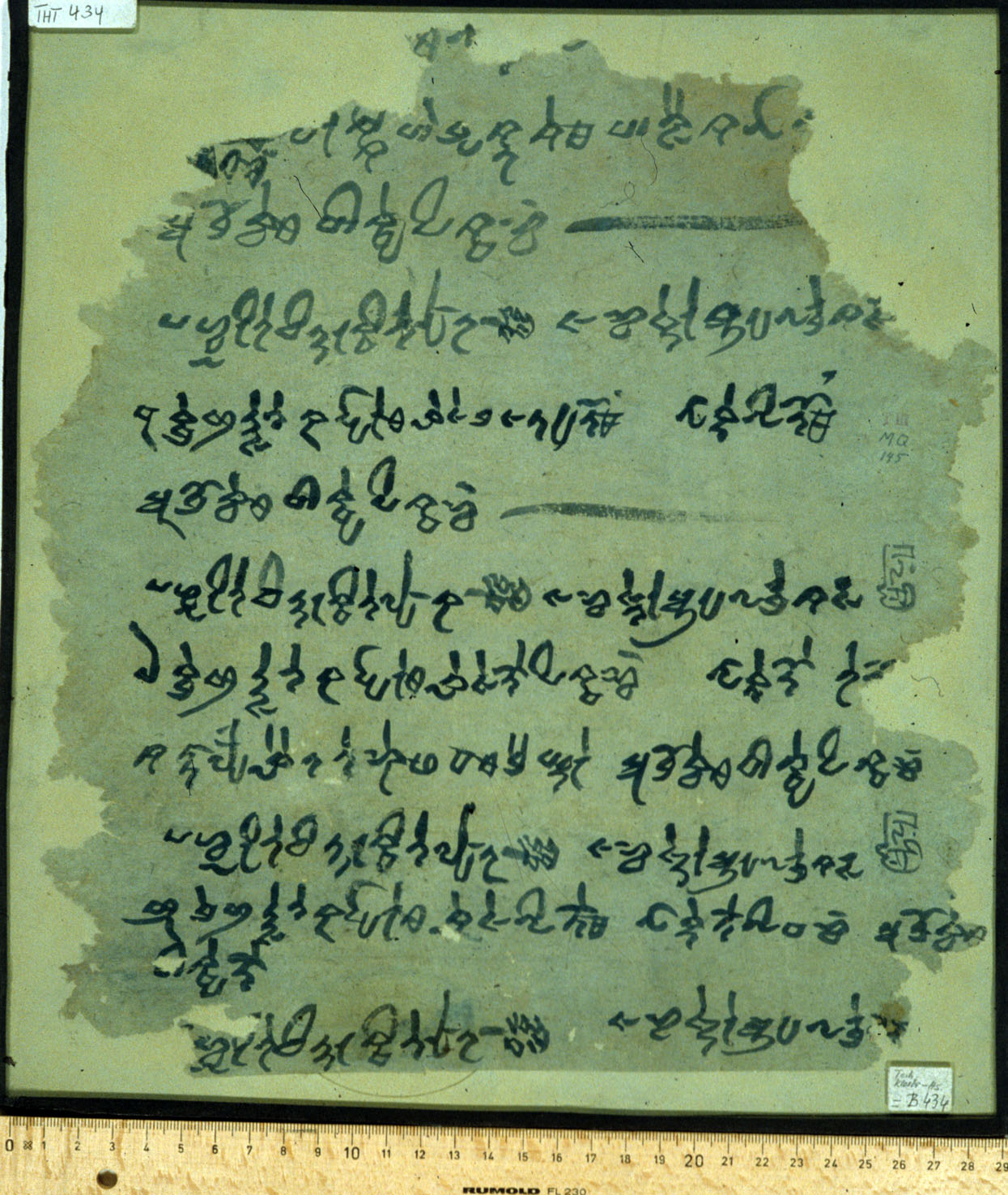
Images from idp.bbaw.de by courtesy of the International Dunhuang Project Berlin, the Berlin-Brandenburgische Akademie der Wissenschaften, and the Staatsbibliothek zu Berlin – Orientabteilung.
CEToM | THT 434
| Known as: | THT 434; B 434 |
|---|---|
| Cite this page as: | Adrian Musitz. "THT 434". In A Comprehensive Edition of Tocharian Manuscripts (CEToM). Created and maintained by Melanie Malzahn, Martin Braun, Hannes A. Fellner, and Bernhard Koller. https://cetom.univie.ac.at/?m-tht434&outputformat=print (accessed 05 Jul. 2025). |
Edition | |
| Editor: | Adrian Musitz |
Provenience | |
| Main find spot: | Kizil Ming-öy |
| Collection: | Berlin Turfan Collection |
Language and Script | |
| Language: | TB |
| Linguistic stage: | late |
| Script: | cursive |
Text contents | |
| Text genre: | Non-literary |
| Text subgenre: | Account |
| Verse/Prose: | prose |
Object | |
| Material: | ink on paper |
| Form: | Scroll |
Images from idp.bbaw.de by courtesy of the International Dunhuang Project Berlin, the Berlin-Brandenburgische Akademie der Wissenschaften, and the Staatsbibliothek zu Berlin – Orientabteilung.
| a1 | /// sw· ·t· – /// |
|---|---|
| a2 | – «pa¯» «¯s» [p]· r[e] śśi ye mpa śka śe¯ ¯m ya ksai śa wā /// |
| a3 | a mo kce¯ ¯s yi kṣye pi śṣa ṅkaṃ ÷ |
| a4 | pa ñcwa ri ke ci tta ra kṣi te lyā ka ¤ sa ṅka ste re ā rya wa rme śa rsa /// |
| a5 | ṣu kme ña ntse ne ka pyā re¯ ¯s kle se ma sa ta rya to¯ ¯m• wā kte wi to¯ ¯m• |
| a6 | a mo kce¯ ¯s yi kṣye pi śṣa ṅkaṃ ÷ |
| a7 | pa ñcwa ri ke ci tta ra kṣi te lyā ka ¤ sa ṅka ste re ā rya wa rme śa rsa ¤ |
| a8 | o kme ña ntse ne ka pyā re¯ ¯s kle se tau pi śṣa ṅkaṃ wā kte tau ke – (–) |
| a9 | śa ntā lyai klai na te ṅke¯ ¯ś pa¯ ¯s mai yta re a mo kce¯ ¯s yi kṣye pi śṣa ṅkaṃ |
| a10 | pa ñcwa ri ke ci tta ra kṣi te lyā ka ¤ sa ṅka ste re ā rya wa rme śa rsa ¤ |
| a11 | ñu me ña ntse ne ka pyā re¯ ¯s kle se wi tau¯ ¯m wā kte tau wi ṣa ṅkaṃ a mo kce¯ ¯s |
| a12 | yi kṣye tau |
| a13 | – ñcwa ri ke ci tta ra kṣi te lyā ka ¤ sa ṅka ste re ā rya wa rme śa rsa – |
| a1 | /// s w(āk)t(e) – /// |
|---|---|
| a2 | päs p·reśśiyempa śka śem yaksai śawā – /// |
| a3 | amokces yikṣye piś ṣaṅkäṃ ÷ /// |
| a4 | pañcwarike cittarakṣite lyāka ¤saṅkästere āryawarme śarsa /// |
| a5 | ṣuk meñantsene kapyāres klese masa tarya tom wākte wi tom |
| a6 | amokces yikṣye piś ṣaṅkäṃ ÷ |
| a7 | pañcwarike cittarakṣite lyāka ¤saṅkästere āryawarme śarsa |
| a8 | ok meñantse ne kapyāres klese tau piś ṣaṅkäṃ wākte tau ke – /// |
| a9 | śantālyai klaina teṅkeś päs maiytare amokces yikṣye piś ṣaṅkäṃ |
| a10 | pañcwarike cittarakṣite lyāka ¤saṅkästere āryawarme śarsa |
| a11 | ñu meñantsene kapyāres klese wi taum wākte tau wi ṣaṅkäṃ amokces |
| a12 | yikṣye tau |
| a13 | (pa)ñcwarike cittarakṣite lyāka ¤saṅkästere āryawarme (śarsa) /// |
| a1 | /// ...wākte to ... /// |
|---|---|
| a2 | He also came back with ... They ate yakso... |
| a3 | Flour for the artisans: five pints... /// |
| a4 | The Pañcwarike Cittarakṣite saw it ¤. The Saṅkästere Āryawarme knew about it /// |
| a5 | On day of the month seven, klese for the kapyāri was spent: three pecks. wākte: two pecks. |
| a6 | Flour for the artisans: five pints. |
| a7 | The Pañcwarike Cittarakṣite saw it ¤. The Saṅkastere Āryawarme knew about it ¤. |
| a8 | On day of the month eight, klese for the kapyāri: a peck, five pints. wākte: a peck. |
| a9 | ... the women went away to Teṅken1 . Flour for the aritsans: five pints. |
| a10 | The Pañcwarike Cittarakṣite saw it ¤. The Saṅkastere Āryawarme knew about it ¤. |
| a11 | On day of the month nine, klese for the kapyāri: two pecks. wākte: a peck, two pints. |
| a12 | Flour for the artisans: a peck. |
| a13 | The Pañcwarike Cittarakṣite saw it ¤. The Saṅkastere Āryawarme knew about it. |
| n1 | śantālyai is an obscure word. Ching and Ogihara connect it to śaiyye (pl. śānta) 'sheep'. However, 'shepherd women' doesn't seem to be correct, as one would expect *śantālyana klaina. It especially doesn't fit in THT 472 a1. Ching and Ogihara connect Teṅke to Chinese 鄧. |
|---|
Sieg and Siegling 1953: 289-290; Ching 2010: 278-279; Ching and Ogihara 2010: 83-85; Thomas 1957: 138
Ching, Chao-jung. 2010. “Secular documents in Tocharian: Buddhist economy and society in the Kucha region.” PhD, Paris: École Pratique des Hautes Études.
Ching, Chao-jung, and Hirotoshi Ogihara. 2010. “Internal relationships and dating of the Tocharian B monastic accounts in the Berlin collection.” Studies on the Inner Asian Languages 25: 75–141. http://hdl.handle.net/11094/26143.
“The International Dunhuang Project: The Silk Road Online.” n.d. http://idp.bl.uk.
Sieg, Emil, and Wilhelm Siegling. 1953. Tocharische Sprachreste. Sprache B, Heft 2. Fragmente Nr. 71-633. Edited by Werner Thomas. Göttingen: Vandenhoeck & Ruprecht.
Thomas, Werner. 1957. Der Gebrauch der Vergangenheitstempora im Tocharischen. Wiesbaden: Harrassowitz.
Gippert, Jost, Katharina Kupfer, Christiane Schaefer, and Tatsushi Tamai. n.d. “Thesaurus Indogermanischer Text- und Sprachmaterialien (TITUS): Tocharian Manuscripts from the Berlin Turfan Collection.” http://titus.fkidg1.uni-frankfurt.de/texte/tocharic/thtframe.htm.
https://cetom.univie.ac.at/?m-tht434&outputformat=print
Output automatically generated on Sat, 2025-07-05, 21:36:53 (CEST).
Page last edited on Mon, 2024-10-07, 16:36:03 (CEST), by Automatic conversion. Version 41.
Page created on Sat, 2012-03-17, 18:50:14 (CET), by Automatic conversion.
Medieninhaber: Universität Wien, Institut für Sprachwissenschaft | Inhalt: Melanie Malzahn | Programmierung: Martin Braun | Datenkonvertierung: Bernhard Koller | Design: Patricia Katharina Hoda
Datenschutzerklärung || Erklärung zur Barrierefreiheit || Copyright: Die Gesamtsite, alle enthaltenen Informationen, Grafiken, Seiten, eingetragene Markenzeichen und Ähnliches unterliegen dem Urheberrecht des jeweiligen Inhabers. Alle Rechte vorbehalten.