
THT 542
| Known as: | THT 542; B 542; Bleistiftnummer 2428 |
|---|---|
| Cite this page as: | Adrian Musitz (translation). "THT 542". In A Comprehensive Edition of Tocharian Manuscripts (CEToM). Created and maintained by Melanie Malzahn, Martin Braun, Hannes A. Fellner, and Bernhard Koller. https://cetom.univie.ac.at/?m-tht542 (accessed 05 Jul. 2025). |
Edition | |
| Editor: | Adrian Musitz (translation) |
Provenience | |
| Main find spot: | Murtuk |
| Expedition code: | T III M 140.1 |
| Collection: | Berlin Turfan Collection |
Language and Script | |
| Language: | Skt.; TB |
| Linguistic stage: | classical |
| Script: | classical |
Text contents | |
| Title of the work: | Bilingual about doctrinal terminology |
| Text genre: | Literary |
| Text subgenre: | Doctrine |
| Verse/Prose: | prose |
Object | |
| Manuscript: | THT 542-544 |
| Material: | ink on paper |
| Form: | Poṭhī |
| Number of lines: | 7 |
Images
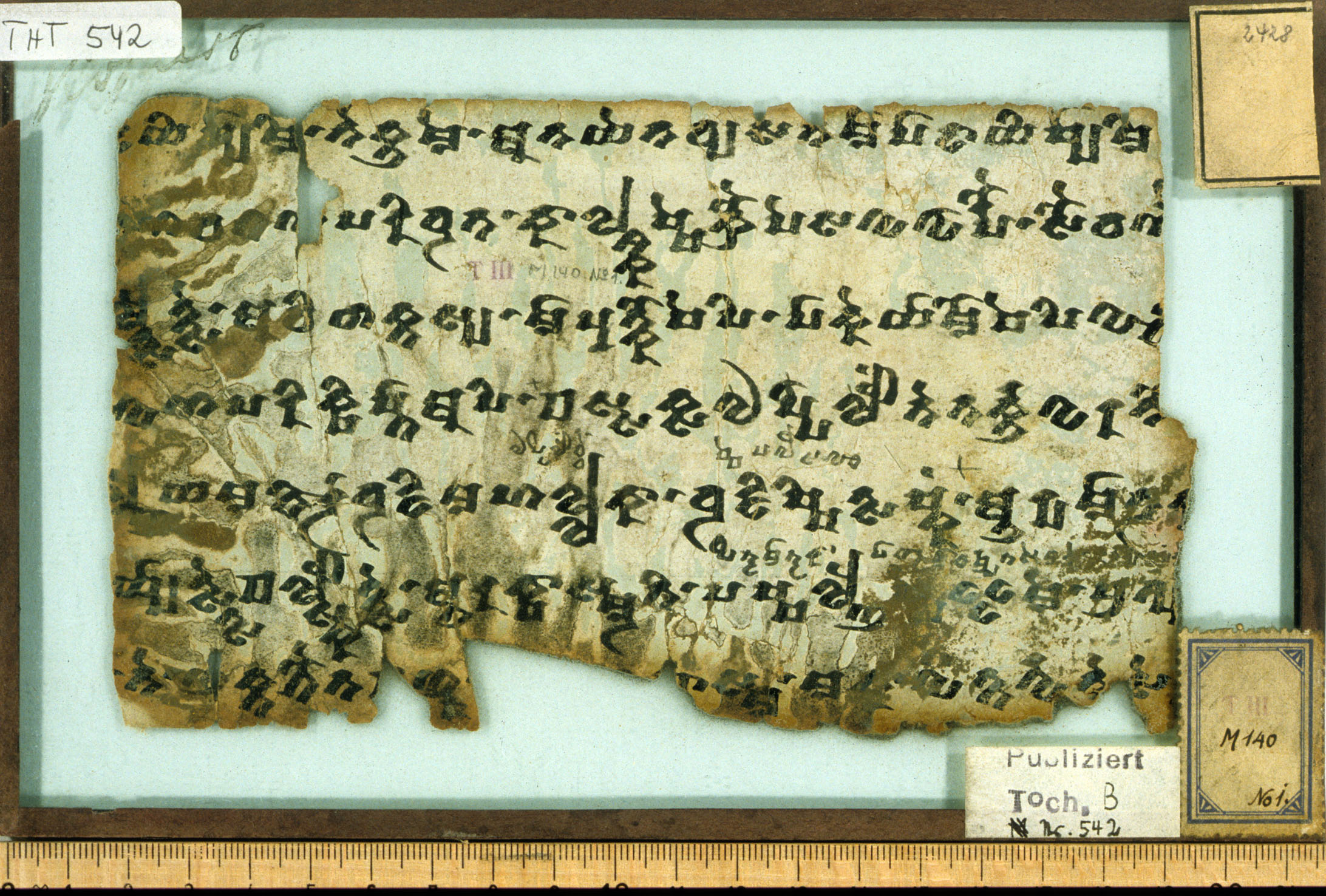
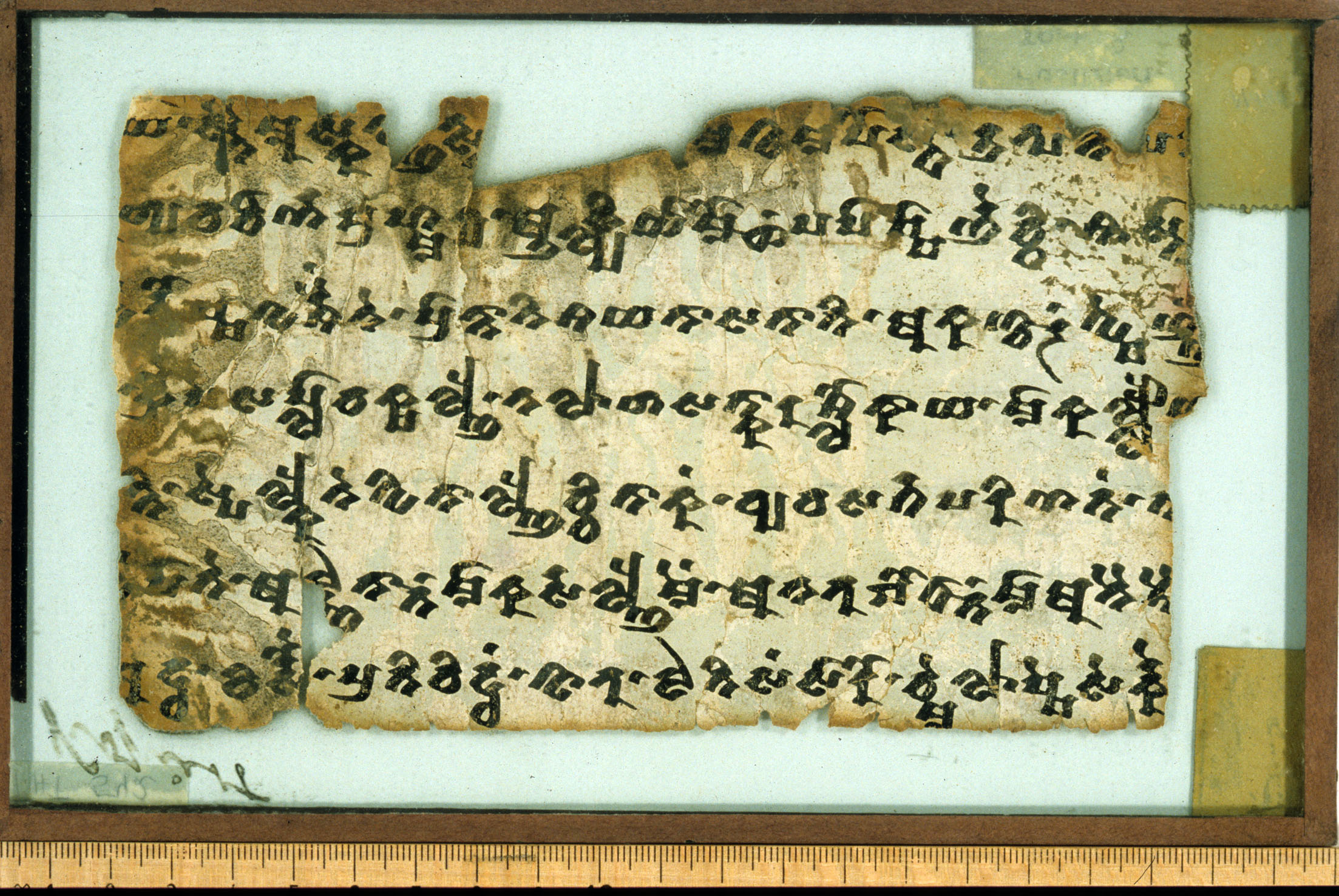
Images from idp.bbaw.de by courtesy of the International Dunhuang Project Berlin, the Berlin-Brandenburgische Akademie der Wissenschaften, and the Staatsbibliothek zu Berlin – Orientabteilung.
Transliteration
| a1 | /// [da] yi ṣyā mi • ne ku me • a na ye na vya sa na mā pā dā yi ṣyā mi /// |
|---|---|
| a2 | /// [mā] ṇa va ga [ṇa] pa ri vṛ ta • kā lśka ṣṣe krau pe sa wa wā rpau • sau va rṇe /// |
| a3 | /// ltse ntse • a vi bha kta sya • mā pu tko ṣe pi • pā ke yā mo ṣe pi wa¯ ¯t /// |
| a4 | /// gu ṇa pa ri kṣi ptā a pi • pa ssa ksa o ppī loṃ te ta rku wa ra no /// |
| a5 | /// lñe ya ma nta¯ ¯r • vṛ ji ma ha lla kā • vṛ ji ṣṣi tsa ṣkaṃ • ā rya mā tṛ [k]· /// |
| a6 | /// yyā tstse pa lsko ntse • ā ra kṣā smṛ ti • pa ṣṣa lñe ṣṣe i me • pra tyu /// |
| a7 | /// te • ña kta gau ta [ma] ññu – – – ·ā sma • ma kā wä nta rwa ne se /// |
| b1 | /// y· • snai mu sk[ā] lñ· ts·a – – – m[ā] ai ma po staṃ • u tpa nn· p· /// |
| b2 | /// bhya va cī rṇa bra hma rya • ā klyi yā mo¯ ¯s̝ pa pā ṣṣo rñe cci • śā stā /// |
| b3 | /// [wä] rtto ṣṣa wa rśaiṃ ne • prā ntā ni śa ya nā sa nā ni • a ka ñca¯ ¯r wṣe ññaṃ /// |
| b4 | /// • krau pe sa plā ca kṣa lñe • na lā bha sa tkā ra ślo kā ya • mā ka llau [y]· /// |
| b5 | /// nti • spe lke ne wi nā lñe cci tā kaṃ • vya va sa rga pa ri ṇa taṃ • t· /// |
| b6 | /// [wä] rpā te • a jñā nā¯ ¯t • mā ka rsa lñe meṃ • a na nu bo dhā¯ ¯t • mā a nai śai /// |
| b7 | /// bu ddhaṃ • ka rsau • pra ti vi ddhaṃ • au nu • jā ti saṃ sā ro • cme lā ṣṣe se rke /// |
Transcription
| a1 | /// dayiṣyāmi • nekume • anayena vyasanam āpādāyiṣyāmi /// |
|---|---|
| a2 | /// māṇavagaṇaparivṛta • kālśkaṣṣe kraupesa wawārpau • sauvarṇe /// |
| a3 | /// ltsentse • avibhaktasya • mā putkoṣepi • pāke yāmoṣepi wat /// |
| a4 | /// guṇaparikṣiptā api • pässaksa oppīloṃ tetarkuwa rano /// |
| a5 | /// lñe yamantär • vṛjimahallakā • vṛjiṣṣi tsaṣkaṃ • āryamātṛk(ā) /// |
| a6 | /// yyātstse pälskontse • ārakṣāsmṛti • paṣṣalñeṣṣe ime • pratyu /// |
| a7 | /// te • ñakta gautamäññu – – – ·ā sma • makā wäntarwa nese /// |
| b1 | /// y· • snai muskālñ(e)ts(ts)a – – – mā aima postäṃ • utpann· p· /// |
| b2 | /// bhyavacīrṇa brahmarya • āklyi yāmoṣ papāṣṣorñecci • śāstā /// |
| b3 | /// wärttoṣṣa warśaiṃne • prāntāni śayanāsanāni • akañcar wṣeññaṃ /// |
| b4 | /// • kraupesa plāc akṣalñe • na lābhasatkāraślokāya • mā kallau y· /// |
| b5 | /// nti • spelkene winālñecci tākaṃ • vyavasargapariṇataṃ • t· /// |
| b6 | /// wärpāte • ajñānāt • mā karsalñemeṃ • ananubodhāt • mā anaiśai /// |
| b7 | /// buddhaṃ • kärsau • pratividdhaṃ • aunu • jātisaṃsāro • cmelāṣṣe serke /// |
Translation
| a1 | ... I will destroy them.. Through bad conduct I will cause disaster... |
|---|---|
| a2 | ... surrounded by a group of youths... in golden... |
| a3 | ... of the unseparated, or of the one having taken part in... |
| a4 | ... even having a garland around their necks... |
| a5 | ... will do... Elders from Vṛji, having noble mothers... |
| a6 | ... powerful... of the mind... the notion of protection... |
| a7 | ... lord Gautama... are many things... |
| b1 | ... undecaying... |
| b2 | ... having studied, well-behaved... |
| b3 | ... of the woods... in the thicket... distand quarters... |
| b4 | ... proclaiming the word to the assembly... ... not the profit... |
| b5 | ... if they are having pleasure in zeal, ... ripened by abandonment... |
| b6 | ... enjoyed... Out of ignorance and lack of comprehension... |
| b7 | ... knowing, struck... The cycle of births... |
Other
| a1 | [skt:] I will destroy [tb:] I will destroy them (Peyrot 2013b: 290) |
|---|---|
| a5 | they will do … (Peyrot 2013b: 290) |
| b2 | ayant étudié, dotés du comportement vertueux. (Meunier 2013: 175) |
| b5 | [skt:] (if the monks) are (not) eager for action ◆ [tb:] (if the monks) are (not) eager in zeal (Peyrot 2013b: 683) |
References
Online access
Edition
Sieg and Siegling 1953: 339-340
Translations
Hackstein 1995: a1 (85), b1 (190); Krause 1952: a4 (183); Meunier 2013: b2 (175); Peyrot 2013b: a1 (290), a5 (290), b5 (683); Thomas 1972: a3 (449)
Bibliography
Hackstein, Olav. 1995. Untersuchungen zu den sigmatischen Präsensstammbildungen des Tocharischen. HS Erg.-Heft 38. Göttingen: Vandenhoeck & Ruprecht.
“The International Dunhuang Project: The Silk Road Online.” n.d. http://idp.bl.uk.
Krause, Wolfgang. 1952. Westtocharische Grammatik, Band I. Das Verbum. Heidelberg: Winter.
Meunier, Fanny. 2013. “Typologie des locutions en yām- du tokharien.” Tocharian and Indo-European Studies 14: 123–85.
Peyrot, Michaël. 2013b. The Tocharian subjunctive. A study in syntax and verbal stem formation. Vol. 8. Brill’s Studies in Indo-European Languages & Linguistics. Leiden/Boston: Brill.
Sieg, Emil, and Wilhelm Siegling. 1953. Tocharische Sprachreste. Sprache B, Heft 2. Fragmente Nr. 71-633. Edited by Werner Thomas. Göttingen: Vandenhoeck & Ruprecht.
Thomas, Werner. 1972. “Zweigliedrige Wortverbindungen im Tocharischen.” Orbis 21: 429–70.
Gippert, Jost, Katharina Kupfer, Christiane Schaefer, and Tatsushi Tamai. n.d. “Thesaurus Indogermanischer Text- und Sprachmaterialien (TITUS): Tocharian Manuscripts from the Berlin Turfan Collection.” http://titus.fkidg1.uni-frankfurt.de/texte/tocharic/thtframe.htm.

