THT 336
| Known as: | THT 336; B 336; Bleistiftnummer 2700 |
|---|---|
| Cite this page as: | Adrian Musitz (translation). "THT 336". In A Comprehensive Edition of Tocharian Manuscripts (CEToM). Created and maintained by Melanie Malzahn, Martin Braun, Hannes A. Fellner, and Bernhard Koller. https://cetom.univie.ac.at/?m-tht336 (accessed 02 Jul. 2025). |
Edition | |
| Editor: | Adrian Musitz (translation) |
Provenience | |
| Main find spot: | Kizil Ming-öy |
| Expedition code: | T III MQR 17 |
| Collection: | Berlin Turfan Collection |
Language and Script | |
| Language: | TB |
| Linguistic stage: | archaic |
| Script: | classical |
Text contents | |
| Text genre: | Literary |
| Text subgenre: | Vinaya |
| Verse/Prose: | prose |
Object | |
| Material: | ink on paper |
| Form: | Poṭhī |
| Number of lines: | 7 |
Images
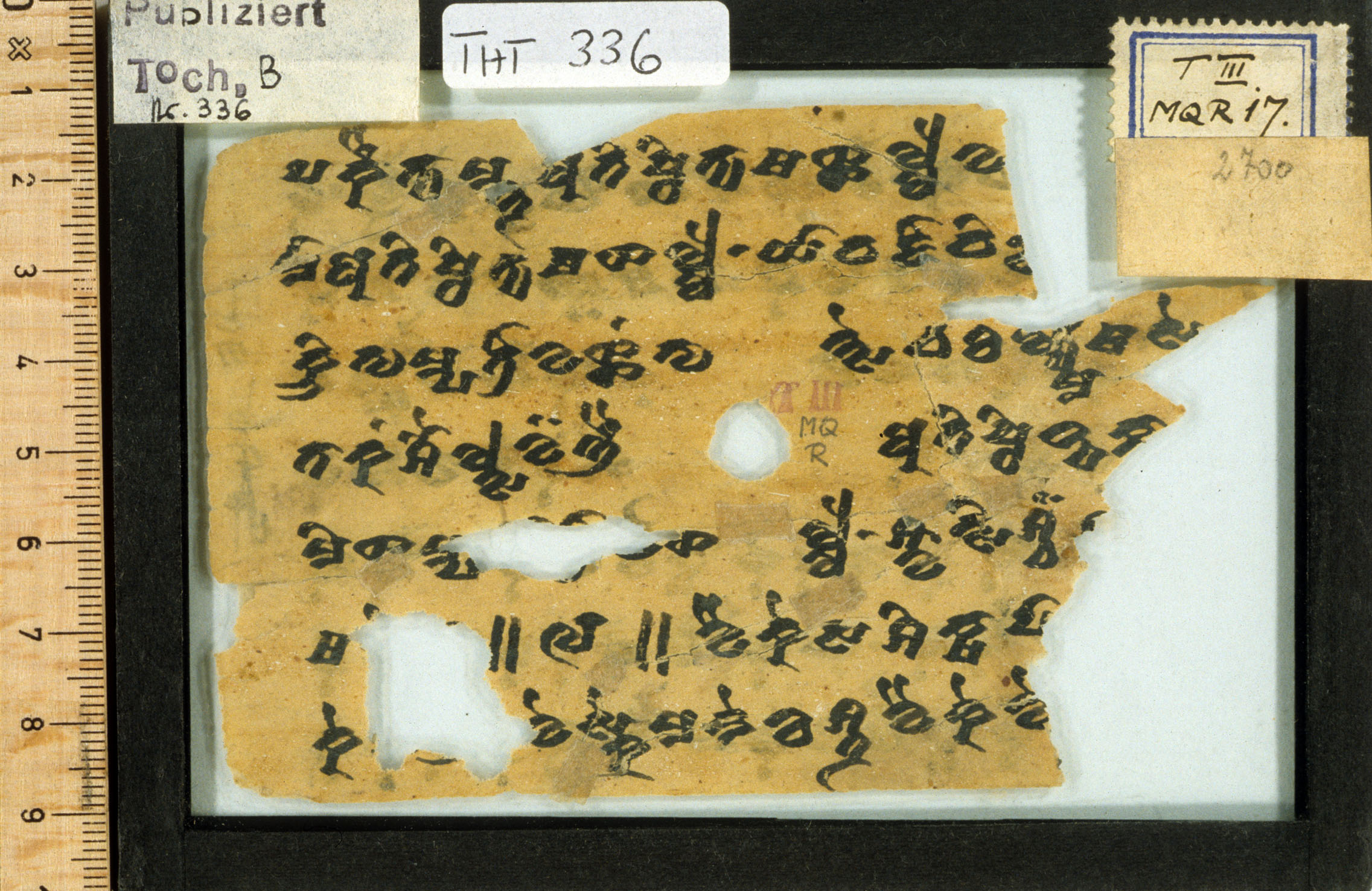
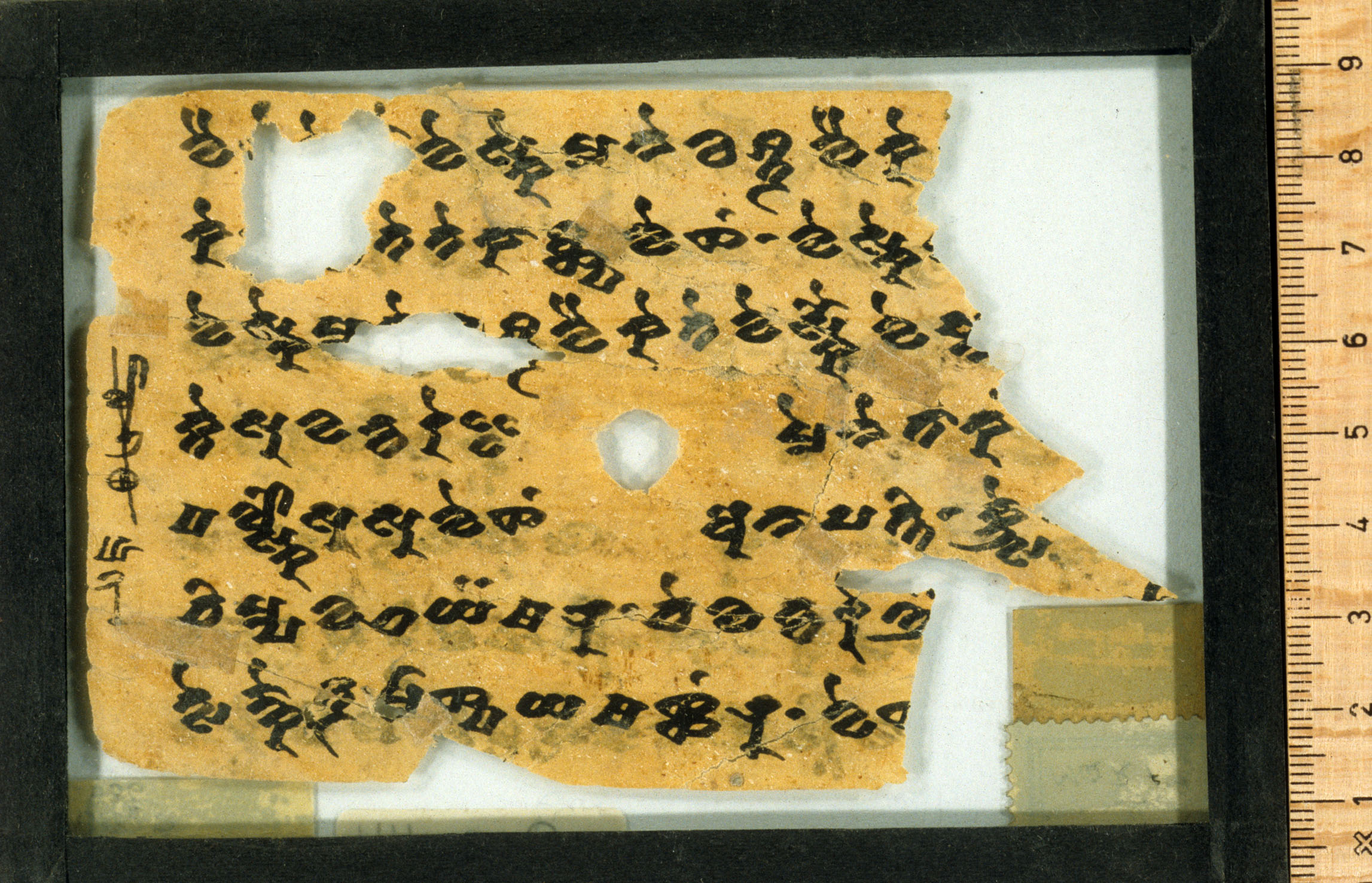
Images from idp.bl.uk by courtesy of the International Dunhuang Project, the Berlin-Brandenburgische Akademie der Wissenschaften, and the Staatsbibliothek zu Berlin – Orientabteilung.
Transliteration
| lf | 10 9 |
|---|---|
| a1 | pa rkai tyā mttra a ti ṣṭhi tya ma s̝s̝a lle wa /// |
| a2 | mā a ti ṣṭhi tya ma s̝a lle • yā va jī vi /// |
| a3 | krui tu mpa trī wa s̝s̝aṃ tu ntse e ka lym· ma s·e /// |
| a4 | tā kaṃ śau ltsa wä rñai a ti ṣṭhi tpa k[n]ā /// |
| a5 | mi s̝a mpa – ·ī [wa] s̝a lle • śwā tsi ścä /// |
| a6 | ma – || 30 || wai ke sa śi kṣā pā /// |
| a7 | ke – – we ske ma ne ai śtra wai ke we /// |
| b1 | wai ·e ·e ·[au] we ske ma ne ai śtra wai ke /// |
| b2 | ke – – te te kā ks̝pa we s̝aṃ • we ske [m]· /// |
| b3 | we ske ma ·e – ś[t]ra wai ke te we skau we ṣ[na] /// |
| b4 | kte su wa nta re i me ne tā kaṃ /// |
| b5 | pa lsko sa su we s̝aṃ a nā pa tti • kuse /// |
| b6 | ci mpa wa¯ ¯t yä ma 60 ce wa nta re ñ[ä] /// |
| b7 | tse ṅke tra mā s̝pa ya ma s̝s̝aṃ 60 we [s̝a] /// |
Transcription
| lf | 10-9 |
| a1 | parkait yāmtträ atiṣṭhit yamäṣṣälle wa /// |
|---|---|
| a2 | mā atiṣṭhit yamäṣälle • yāvajīvi /// |
| a3 | krui tumpa trīwaṣṣäṃ tuntse ekälym(i) mäs(k)e /// |
| a4 | tākaṃ śaultsa wärñai atiṣṭhit päknā /// |
| a5 | miṣämpa (mā) (tr)īwaṣälle • śwātsiścä /// |
| a6 | mä – ॥ 30 ॥ waikesa śikṣāpā /// |
| a7 | ke – – weskemane aiśträ waike we /// |
| b1 | wai(k)e (w)e(sk)au weskemane aiśträ waike /// |
| b2 | ke – – tetekāk ṣpä weṣäṃ • weskem· /// |
| b3 | weskema(n)e (ai)śträ waike te weskau weṣn a /// |
| b4 | kte su wantäre imene tākaṃ /// |
| b5 | pälskosa su weṣäṃ anāpatti • kuse /// |
| b6 | cimpa wat yämä 60 ce wantäre ñä /// |
| b7 | tseṅketrä mā ṣpä yamäṣṣäṃ 60 weṣä /// |
Translation
| a1 | ... if... makes parkait, is to be controlled... |
|---|---|
| a2 | ... is not to be controlled... |
| a3 | If he mixes (this) with that, it is in the power of that. |
| a4 | ... if... is..., ... (intends to) control... for his whole life... |
| a5 | ... is to be mixed with raw meat. |
| a5+ | To eat... |
| a6+ | Through a lie... precept... and telling (a lie) knows it... |
| a7 | ... lie... |
| b1 | "I am telling a lie" (and) telling it, he knows... lie... |
| b2 | ... and immediately says: Telling... |
| b3 | ... telling (it), he knows... "I am telling a lie", he says... |
| b4 | If this matter is in the mind... |
| b5 | ... he says it with his mind: No offence. |
| b6 | Which monk... or with you... |
| b6+ | This matter... arises... |
| b7 | And he doesn't do it. ... says... |
Other
| a7 | Which [monk] thinks, «I will tell a lie», [and] telling it he knows, «I am telling a lie» (Peyrot 2013b: 292) |
|---|---|
| b1+ | … «I will tell a lie», [and while] speaking he knows, «(I am telling) a lie», [but] afterwards he does not know it [anymore], then it was no lie. (Peyrot 2013b: 292) |
| b2 | [If] beforehand he does not intend to tell a lie, [and] suddenly he tells [one while] speaking, … (Peyrot 2013b: 292) |
| b3 | … [if] speaking he knows, «I am telling a lie», [and] indeed he says that thing, then that thing is not a lie. (Peyrot 2013b: 292) |
| b5 | Which monk says this, «I will give this to you», [but] does not give it; (Peyrot 2013b: 384) |
| b6 | or, «I will go with you», [but] he does not go; (Peyrot 2013b: 385) |
| b7 | … (which monk) says, «I will not eat anymore», [but] eats again; (Peyrot 2013b: 385) |
Commentary
Remarks
| Bhikṣu-Prātimokṣasūtra? |
Alternative linguistic/paleographic classifications
| Peyrot 2008 | A2 |
| Tamai 2011 | C1 |
| Tamai 2011 | C14 |
References
Online access
Edition
Translations
Peyrot 2013b: a7 (292), b1 (292), b1 first part and PK NS 58 a5 second part (292), b2 (292), b3 (292), b5 (384), b6 (385), b7 (385)
Bibliography
“The International Dunhuang Project: The Silk Road Online.” n.d. http://idp.bl.uk.
Peyrot, Michaël. 2008. Variation and change in Tocharian B. Vol. 15. Leiden Studies in Indo-European. Amsterdam/New York: Rodopi.
Peyrot, Michaël. 2013b. The Tocharian subjunctive. A study in syntax and verbal stem formation. Vol. 8. Brill’s Studies in Indo-European Languages & Linguistics. Leiden/Boston: Brill.
Sieg, Emil, and Wilhelm Siegling. 1953. Tocharische Sprachreste. Sprache B, Heft 2. Fragmente Nr. 71-633. Edited by Werner Thomas. Göttingen: Vandenhoeck & Ruprecht.
Tamai, Tatsushi. 2011. Paläographische Untersuchungen zum B-Tocharischen. Innsbrucker Beiträge zur Sprachwissenschaft 138. Innsbruck: Institut für Sprachen und Literaturen.
Gippert, Jost, Katharina Kupfer, Christiane Schaefer, and Tatsushi Tamai. n.d. “Thesaurus Indogermanischer Text- und Sprachmaterialien (TITUS): Tocharian Manuscripts from the Berlin Turfan Collection.” http://titus.fkidg1.uni-frankfurt.de/texte/tocharic/thtframe.htm.

