THT 412
| Known as: | THT 412; B 412; Bleistiftnummer 2362 |
|---|---|
| Cite this page as: | Melanie Malzahn. "THT 412". In A Comprehensive Edition of Tocharian Manuscripts (CEToM). Created and maintained by Melanie Malzahn, Martin Braun, Hannes A. Fellner, and Bernhard Koller. https://cetom.univie.ac.at/?m-tht412 (accessed 16 Jul. 2025). |
Edition | |
| Editor: | Melanie Malzahn |
| Date of online publication: | 2017-07-17 |
Provenience | |
| Main find spot: | Murtuk |
| Expedition code: | T III M 145.9 |
| Collection: | Berlin Turfan Collection |
Language and Script | |
| Language: | TB |
| Linguistic stage: | classical |
| Script: | classical |
Text contents | |
| Title of the work: | Unidentified story |
| Text genre: | Literary |
| Text subgenre: | Jātaka/Avadāna |
| Verse/Prose: | prose |
Object | |
| Material: | ink on paper |
| Form: | Poṭhī |
| Number of lines: | 4 |
Images
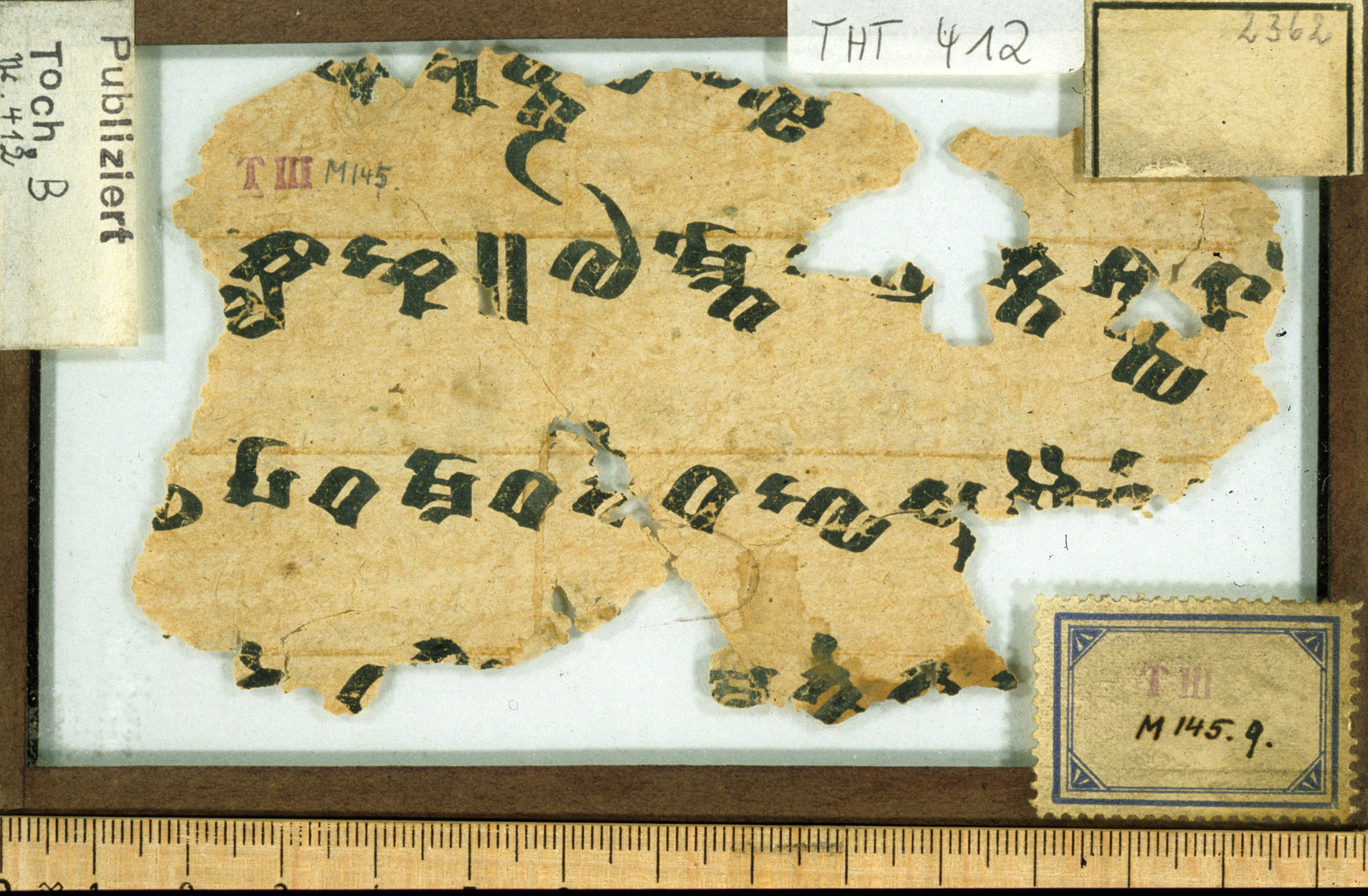
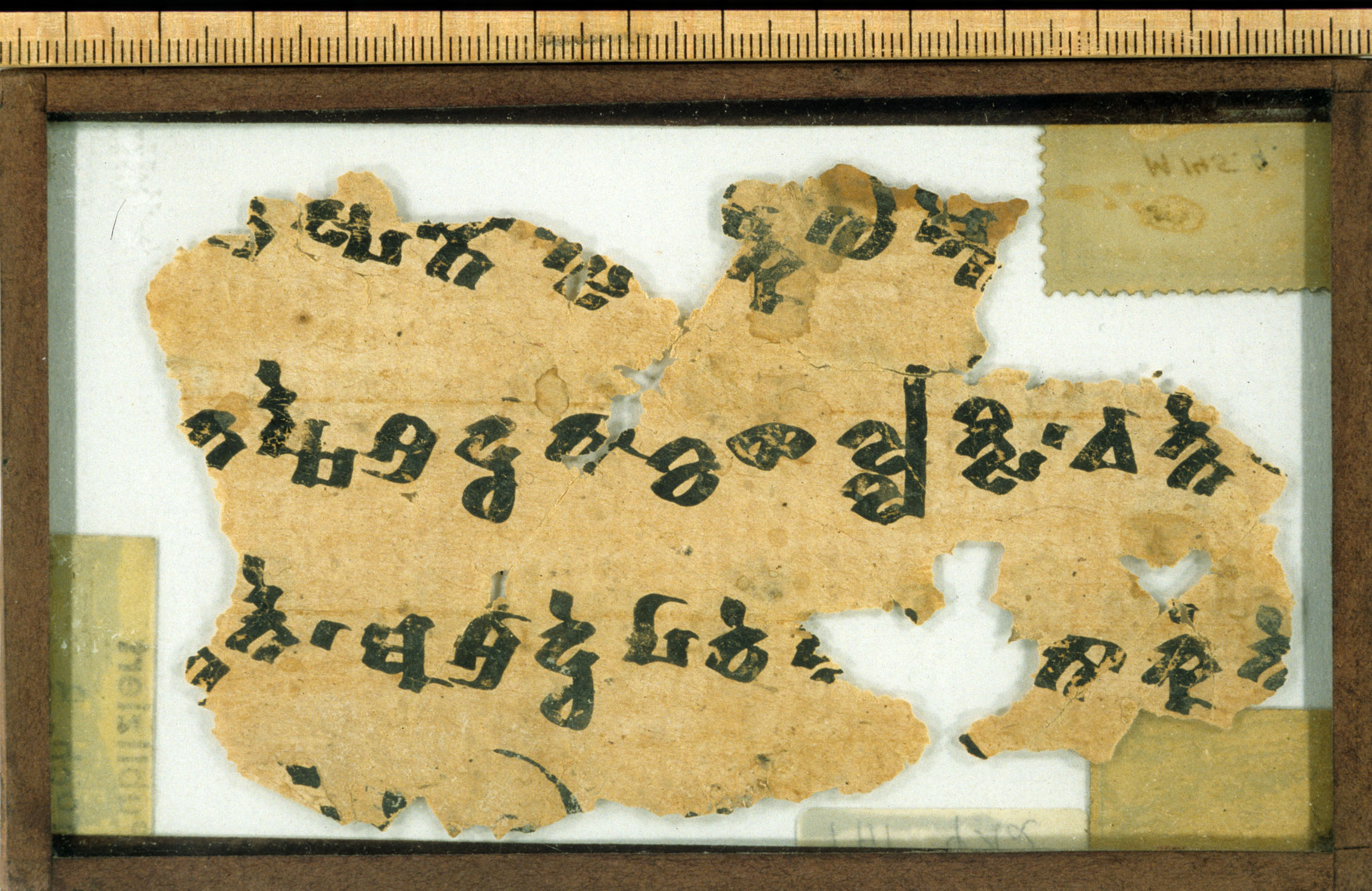
Images from idp.bl.uk by courtesy of the International Dunhuang Project, the Berlin-Brandenburgische Akademie der Wissenschaften, and the Staatsbibliothek zu Berlin – Orientabteilung.
Transliteration
| a1 | /// [s](·) [m]u [d]tra – ·ts· /// |
|---|---|
| a2 | /// klā ṅka || o mno [pa] [ñ](·) kt(·) śtwa rā (·)[ai] /// |
| a3 | /// – pā ta rmā ta rne ta ṅwa s[su] ṣai[¯] [¯m]• /// |
| a4 | /// (·)e – – (– –) m(·)a nte [k](·)a – /// |
| b1 | /// t(·) spa ktā [n]ts(·) (–) ṣk[e] o mte /// |
| b2 | /// [ta] rṣṣe śra ddha tā¯ ¯k s̝a lla tsi • e nte /// |
| b3 | /// (·)[ta] rne • a śrā ddhe pā ce [r]m(·) (–) – tā kaṃ ne /// |
| b4 | /// – – [o] /// |
Transcription
| a1 | /// s(a)mudträ – ·ts· /// |
|---|---|
| a2 | /// klāṅka ॥ om no pañ(ä)kt(e) śtwarā(ts)ai /// |
| a3 | /// – pātär mātärne täṅwassu ṣaim /// |
| a4 | /// ·e – – – – m·ante k·a – /// |
| b1 | n1 /// t· spaktānts(a) (eṃ)ṣke omte /// |
| b2 | /// (pātär) (mā)tärṣṣe śraddhatāk ṣällatsi • ente /// |
| b3 | /// ·tär-ne • aśrāddhe pācer m(ācer) tākaṃ-ne /// |
| b4 | /// – – o /// |
Translation
| a1 | ... the ocean ... |
|---|---|
| a2 | ... (s)he went by wagon. There then the Buddha lord ... the fourfold ... |
| a3 | ... I was beloved by [my] father [and] mother ... |
| a4 | ... |
| b1 | ... (due) to the service ... |
| b2 | ... to bring down the Śrāddha ritual for (father and mother). When ... |
| b3 | ... [If] father [and] mother are a non-believer ... |
Commentary
Philological commentary
| n1 | spaktānts(·) can be restored to a gen.sg. of perl.sg., the latter being more likely; eṃṣke is the most likely restoration for the following form. |
|---|
Alternative linguistic/paleographic classifications
| Tamai 2011 | C1 |
| Tamai 2011 | C14 |
References
Online access
Edition
Bibliography
“The International Dunhuang Project: The Silk Road Online.” n.d. http://idp.bl.uk.
Sieg, Emil, and Wilhelm Siegling. 1953. Tocharische Sprachreste. Sprache B, Heft 2. Fragmente Nr. 71-633. Edited by Werner Thomas. Göttingen: Vandenhoeck & Ruprecht.
Tamai, Tatsushi. 2011. Paläographische Untersuchungen zum B-Tocharischen. Innsbrucker Beiträge zur Sprachwissenschaft 138. Innsbruck: Institut für Sprachen und Literaturen.
Gippert, Jost, Katharina Kupfer, Christiane Schaefer, and Tatsushi Tamai. n.d. “Thesaurus Indogermanischer Text- und Sprachmaterialien (TITUS): Tocharian Manuscripts from the Berlin Turfan Collection.” http://titus.fkidg1.uni-frankfurt.de/texte/tocharic/thtframe.htm.

